How to Analyze Your Competitor's Best Videos (And Learn From Them)
Learn the 6-point framework for reverse-engineering viral videos in your niche. Turn competitor analysis into your own content strategy with AI-powered tools.
A systematic framework for reverse-engineering viral content in your niche
The fastest way to grow on any platform isn't creating from scratch. It's studying what already works. Every viral video in your niche is a free blueprint showing you exactly what your audience wants. But most creators watch competitor videos as fans, not as analysts. This guide shows you how to reverse-engineer any video's success using data, not guesswork. The Video Analyzer makes this process systematic by scoring any video's viral elements in seconds.
<video src="https://s3.us-east-1.amazonaws.com/remotionlambda-useast1-k5qomcb1pb/renders/5ijrbpojhw/out.mp4" controls playsinline style="width:100%;border-radius:12px;margin:24px 0;"></video>
Table of Contents
- Why Competitor Analysis Matters More Than Originality
- How to Find the Right Competitors to Study
- The 6-Point Video Breakdown Framework
- Analyzing Hooks: What Made Them Stop the Scroll
- Decoding Content Structure and Retention
- Turning Analysis Into Your Own Content
- Tools to Automate Competitor Analysis
Why Competitor Analysis Matters More Than Originality
Here's an uncomfortable truth: originality is overrated in short-form content. The creators who grow fastest aren't inventing new formats. They're taking proven formats and executing them better, with their own angle, voice, and expertise.
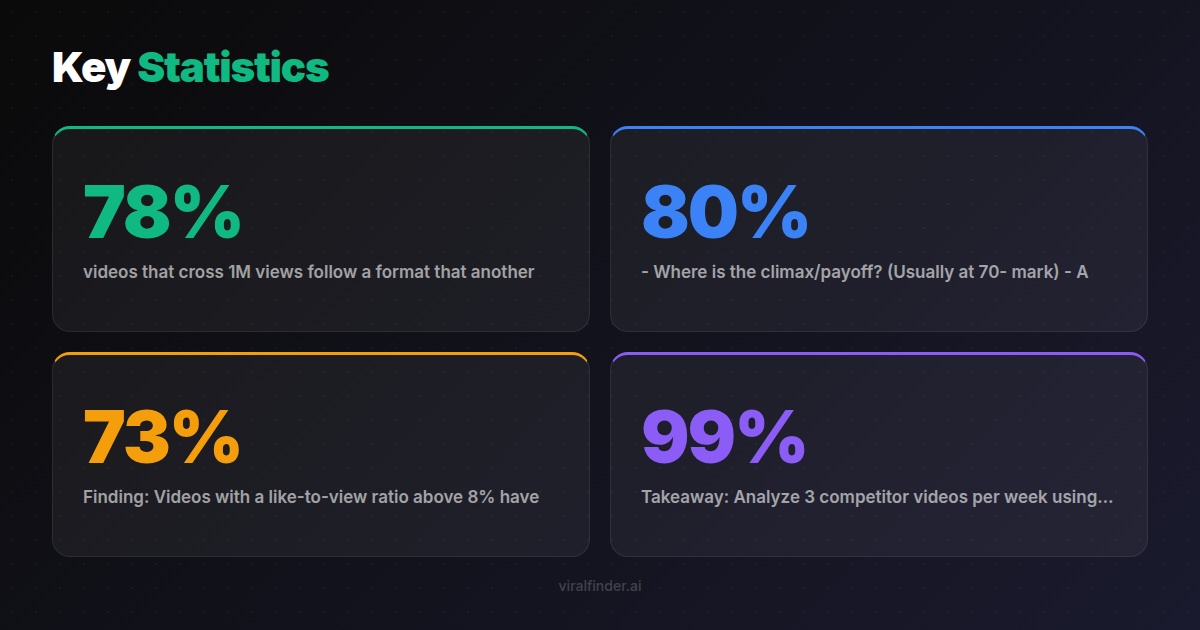
Finding: 78% of videos that cross 1M views follow a format that another creator has already proven works in the same niche.
This isn't copying. It's how every creative industry works. Musicians study other musicians. Filmmakers study other filmmakers. And viral content creators study other viral content creators.
The difference between copying and learning is execution. When you analyze a competitor's video, you're extracting the structural principles that made it work: the hook type, the pacing, the engagement triggers, the CTA format. Then you apply those principles to your own unique content and perspective.
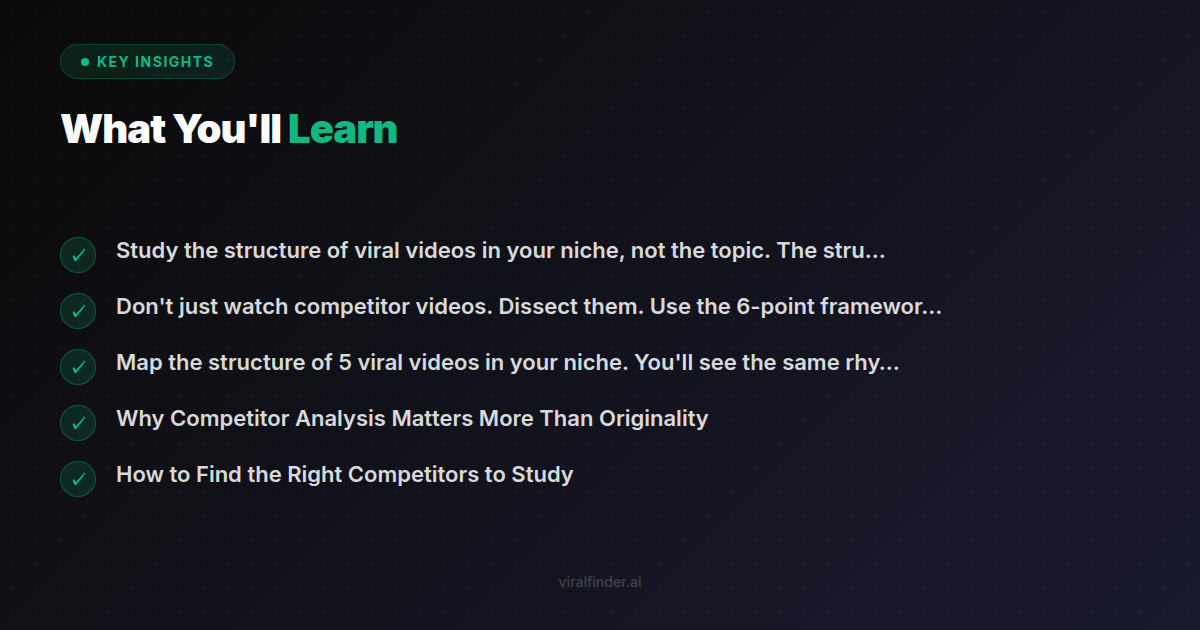
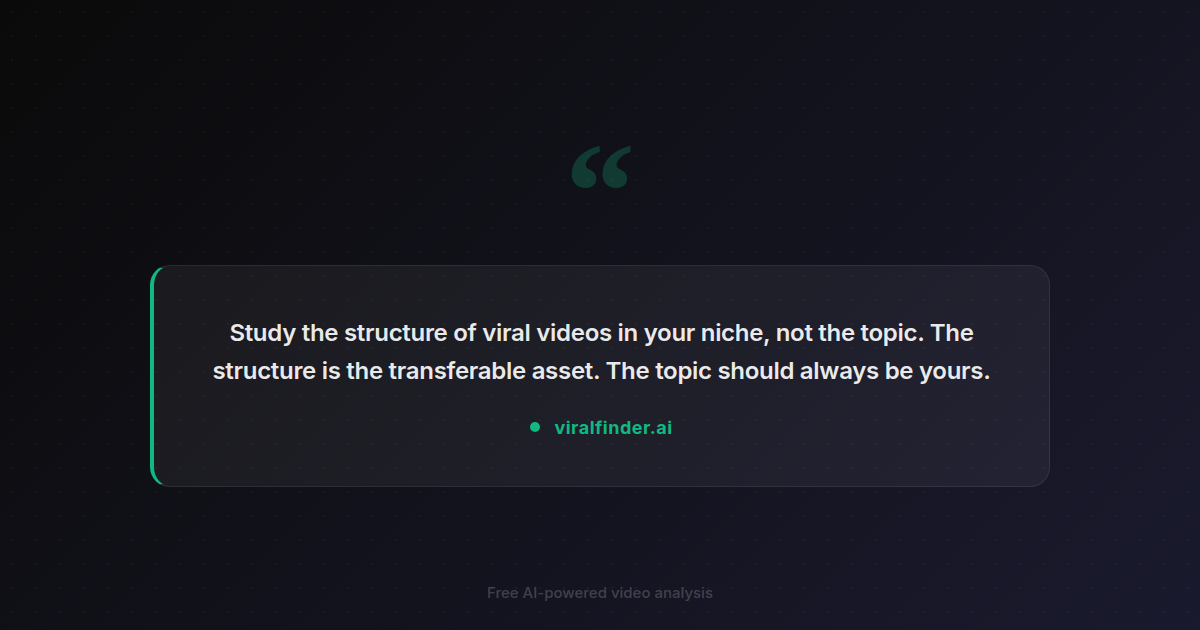
Takeaway: Study the structure of viral videos in your niche, not the topic. The structure is the transferable asset. The topic should always be yours.
How to Find the Right Competitors to Study
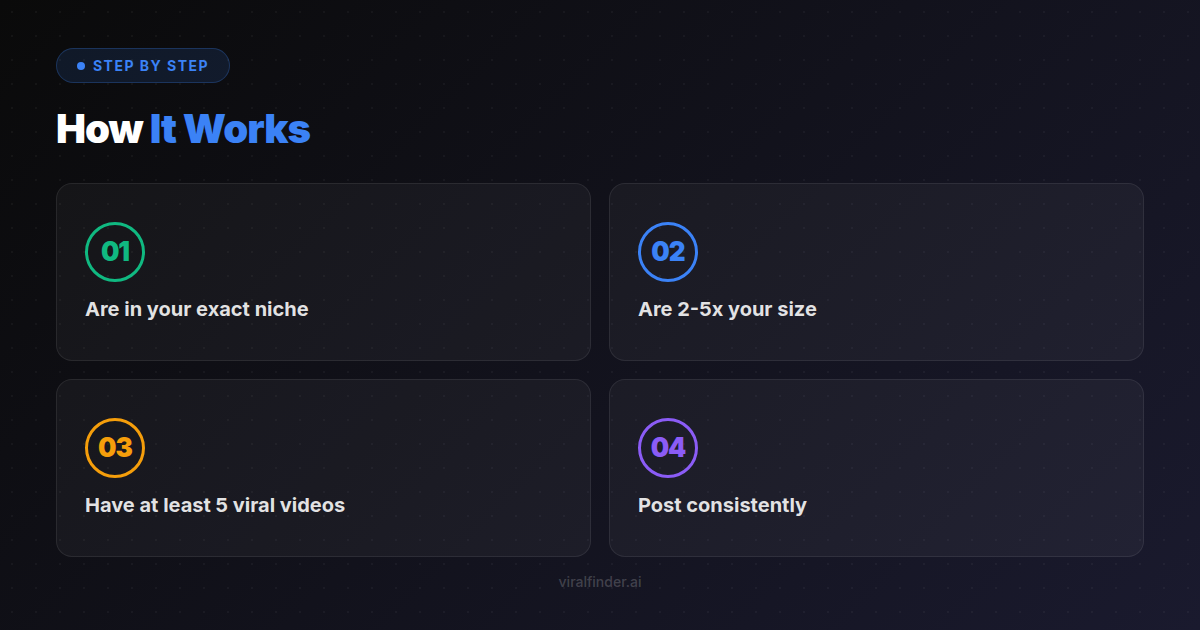
Not all competitors are worth analyzing. You want to study creators who:
- Are in your exact niche (similar audience, similar topics)
- Are 2-5x your size (close enough to be realistic, big enough to learn from)
- Have at least 5 viral videos (one hit could be luck, five is a pattern)
- Post consistently (their strategy is sustainable, not one-off)
Where to Find Them
- TikTok: Search your main keyword, filter by "Most liked" in the past month
- Instagram: Check the Reels tab in Explore for your niche hashtags
- YouTube Shorts: Search your topic and sort by view count
Make a list of 5-10 competitors and bookmark their profiles. You'll revisit them weekly.
Finding: Creators who systematically study 5+ competitors per month grow their following 2.3x faster than those who create content in isolation.
The 6-Point Video Breakdown Framework
When you find a viral video in your niche, analyze it across these six dimensions. For instant scoring, paste the video link into the Video Analyzer.
1. The Hook (First 3 seconds)
- What type of hook is it? (Curiosity, promise, shock, identification)
- What's the first text overlay?
- What's the visual in the first frame?
- How fast does the value proposition arrive?
Copy the opening line and test it in the Hook Analyzer to see its objective score.
2. The Structure
- How long is the video?
- How many distinct sections or points?
- Where is the climax/payoff? (Usually at 70-80% mark)
- Are there pattern interrupts? How often?
3. The Engagement Triggers
- What drives comments? (Question, controversy, choice, challenge)
- Why would someone share this? (Value, humor, relatability)
- Is there a save-worthy moment? (Data, tip, template)
- Does it incentivize replays?
4. The Technical Execution
- Camera angles and changes
- Text overlay style and placement
- Audio quality and music choice
- Editing pace and transitions
5. The Caption and Hashtags
- Caption length and style
- CTA in caption vs. in video
- Hashtag strategy (broad vs. niche)
- Use of keywords for SEO
6. The Performance Data
- View count relative to follower count
- Like-to-view ratio (above 5% is strong)
- Comment-to-view ratio (above 0.5% is strong)
- Share indicators (duets, stitches, saves)
Finding: Videos with a like-to-view ratio above 8% have a 73% chance of being recommended to new audiences by the algorithm, regardless of the creator's follower count.
Takeaway: Don't just watch competitor videos. Dissect them. Use the 6-point framework to turn every viral video into a lesson you can apply.
Analyzing Hooks: What Made Them Stop the Scroll
The hook is the most transferable element of any viral video. Here's how to extract maximum value from competitor hooks:
Step 1: Find their top 10 videos by view count.
Step 2: Write down the exact opening line of each one.
Step 3: Paste each hook into the Hook Analyzer and record the score and type.
Step 4: Look for patterns. Do they consistently use one hook type? Do their highest-performing videos share a specific formula?
Common Patterns You'll Find
The Number Pattern: "7 things that...", "3 mistakes that...", "1 change that..." Most niches over-index on numbered hooks because they promise specific, bounded value.
The "You" Pattern: "Your content isn't bad, your strategy is", "What nobody tells you about..." Identification hooks that directly address the viewer perform consistently.
The Contrast Pattern: "I tried X for 30 days. Here's what happened." Transformation and experiment hooks create irresistible curiosity.
Finding: In any given niche, the top 10 creators typically use only 2-3 hook formulas repeatedly. Finding these formulas for your niche gives you a proven starting point.
Decoding Content Structure and Retention
After the hook, study how the competitor maintains attention throughout the video.
Watch the video 3 times:
- First watch: as a viewer (note where your attention drifts)
- Second watch: count the pattern interrupts and visual changes
- Third watch: map the information flow (setup → tension → payoff)
Create a retention timeline:
0-3s: Hook (curiosity type)
3-8s: Context (quick background)
8-15s: Point 1 (strongest stat)
15-22s: Point 2 (escalation)
22-30s: Pattern interrupt (camera change)
30-40s: Point 3 (the surprise)
40-50s: Payoff (the big reveal)
50-60s: CTA (specific question)
This timeline tells you exactly how the creator structured attention. Now you can apply the same rhythm to your own content.
Takeaway: Map the structure of 5 viral videos in your niche. You'll see the same rhythm repeat. That rhythm is your niche's "attention template."
Turning Analysis Into Your Own Content
Here's the ethical framework for turning competitor analysis into your own videos:
What You CAN Take
- Hook structure and formula (but not exact words)
- Video length and pacing rhythm
- Editing style and pattern interrupt frequency
- CTA format and engagement trigger type
- Content structure (listicle, tutorial, myth-buster)
What You Should NOT Take
- Their exact script or talking points
- Their unique stories or experiences
- Their specific data (cite your own or use public data)
- Their visual branding or on-screen style
The 3-Step Adaptation Process
- Extract the principle. "Their hook uses a specific number + surprising claim format."
- Apply to your expertise. "I'll use the same format with data from my niche."
- Add your unique angle. "I'll contradict the common advice in my space."
Use the Script Reviewer to verify your adapted script scores well on hook, structure, and CTA before filming.
Finding: Adapted content (competitor structure + original angle) outperforms purely original content by 1.9x and competitor copies by 3.4x.
Tools to Automate Competitor Analysis
Manual analysis works but doesn't scale. Here's how to use the Viral Finder tools to speed up the process:
For Quick Video Scoring
Paste any competitor's video link into the Video Analyzer. In under 60 seconds, you'll get:
- Viral score (0-100)
- Hook analysis with frame-by-frame breakdown
- Retention map showing strong and weak sections
- Specific improvement suggestions
For Hook Pattern Analysis
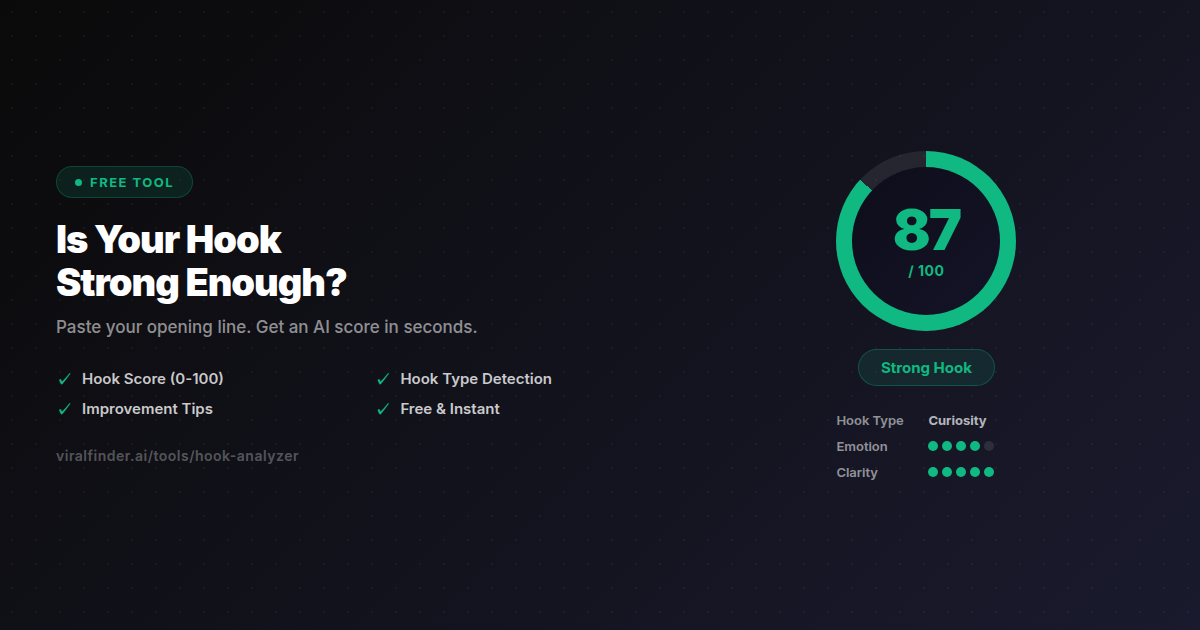
Take the opening line from any competitor video and paste it into the Hook Analyzer to get:
- Hook type classification
- Persuasion strength score
- Specific suggestion for a stronger alternative
For Script Comparison
If you can transcribe a competitor's video, paste the script into the Script Reviewer to see how it scores across hook, structure, and CTA. Then compare your own script against the same criteria.
Building a Competitor Scorecard: Create a simple spreadsheet with columns for: Creator, Video URL, Viral Score, Hook Score, Hook Type, View Count, Engagement Rate. Update it weekly. After a month, you'll have a clear picture of what works in your niche.
Takeaway: Analyze 3 competitor videos per week using the Video Analyzer. In a month, you'll understand your niche's success patterns better than 99% of creators.
Competitor analysis isn't about copying. It's about understanding the game you're playing. The creators who grow fastest are the ones who study the playbook, extract the principles, and execute with their own voice. Start analyzing your competitors today with the Viral Finder tools and turn every viral video in your niche into a growth lesson.
Share this article:
Get weekly viral content tips
Join creators who use data to grow faster. Free tips, strategies, and insights in your inbox.
No spam. Unsubscribe anytime.
How viral is your video?
Paste a TikTok, YouTube, or Instagram link and get an AI viral score 0-100 — with detailed feedback on hook, pacing, and engagement. Free, no signup.
Analyze my video →Try our other free tools