How to Analyze Your TikTok Before Posting (The Data-Backed Method)
Stop guessing. Start knowing exactly how your video will perform before you hit publish. Learn the data-backed method to analyze your TikTok before posting.

How to Analyze Your TikTok Before Posting (The Data-Backed Method)
Stop guessing. Start knowing exactly how your video will perform before you hit publish.
You spent 3 hours editing that TikTok. The lighting is perfect. The transitions are smooth. You're about to post it to your 50,000 followers.
But here's what you don't know: 70% of TikToks fail in the first 2 seconds.
Not because the content is bad. Because the hook didn't land. The pacing was off. The algorithm didn't push it.
What if you could analyze your video before posting and fix these issues? What if you could see exactly why some videos flop while others explode?
That's what this guide is about.
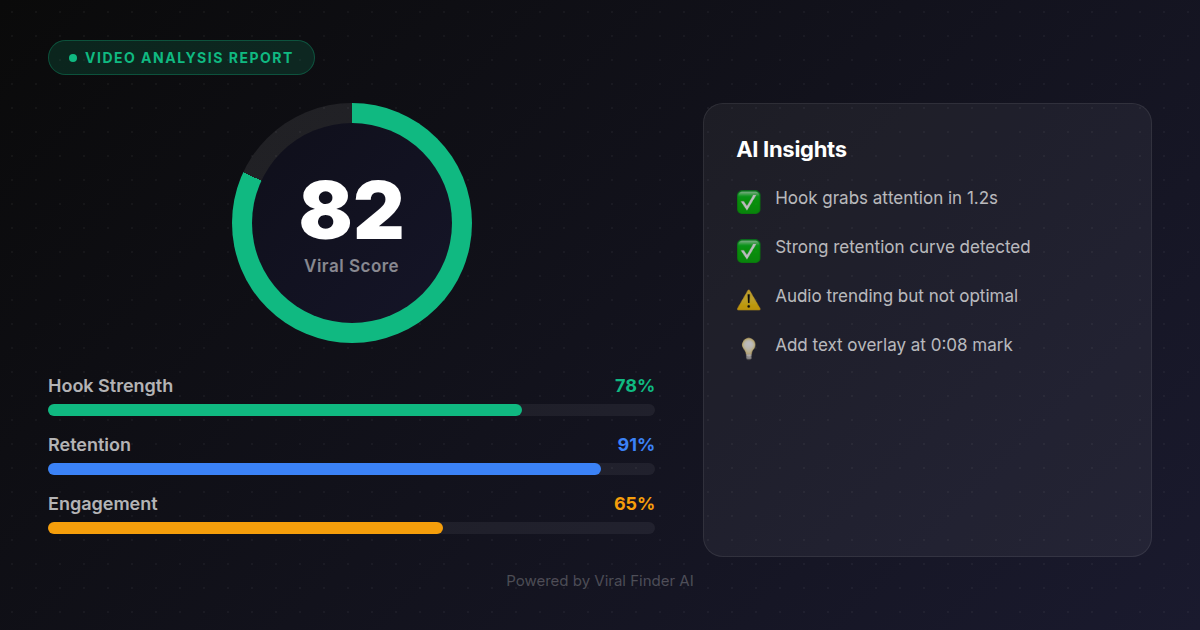
Table of Contents
- Why Most TikToks Fail (And It's Not What You Think)
- The 6 Elements That Predict Viral Success
- How to Analyze Your Hook (The First 3 Seconds)
- Watch Time & Retention: The Metrics That Matter
- The Free Tool That Does This For You
- Step-by-Step: Analyzing Your TikTok Before Posting
Why Most TikToks Fail
Let's get real: the TikTok algorithm doesn't care how hard you worked on your video.
It cares about one thing: does this video keep people on the app?
The algorithm measures this through a brutal feedback loop:
- Your video gets shown to a small test audience (usually 200-500 people)
- If they watch, engage, and don't scroll away → more distribution
- If they scroll → your video dies
The cruel truth: This decision happens in the first 1-3 seconds.
💡 Did you know? 70% of TikToks fail in the first 2 seconds — not because the content is bad, but because the hook didn't land.
Source: TikTok for Business creator insights
Here's what the data shows:
- Videos with 70%+ retention get pushed to the For You Page
- Videos with under 50% retention get buried
- The average TikTok loses 50% of viewers by the 3-second mark
📊 Algorithm fact: Videos with 70%+ retention get pushed to the For You Page. Under 50%? They get buried.
Social media benchmark data via Sprout Social
This is why analyzing your video before posting isn't optional anymore. It's survival.
The 6 Elements That Predict Viral Success
After analyzing thousands of viral TikToks, these are the elements that separate the winners from the losers:
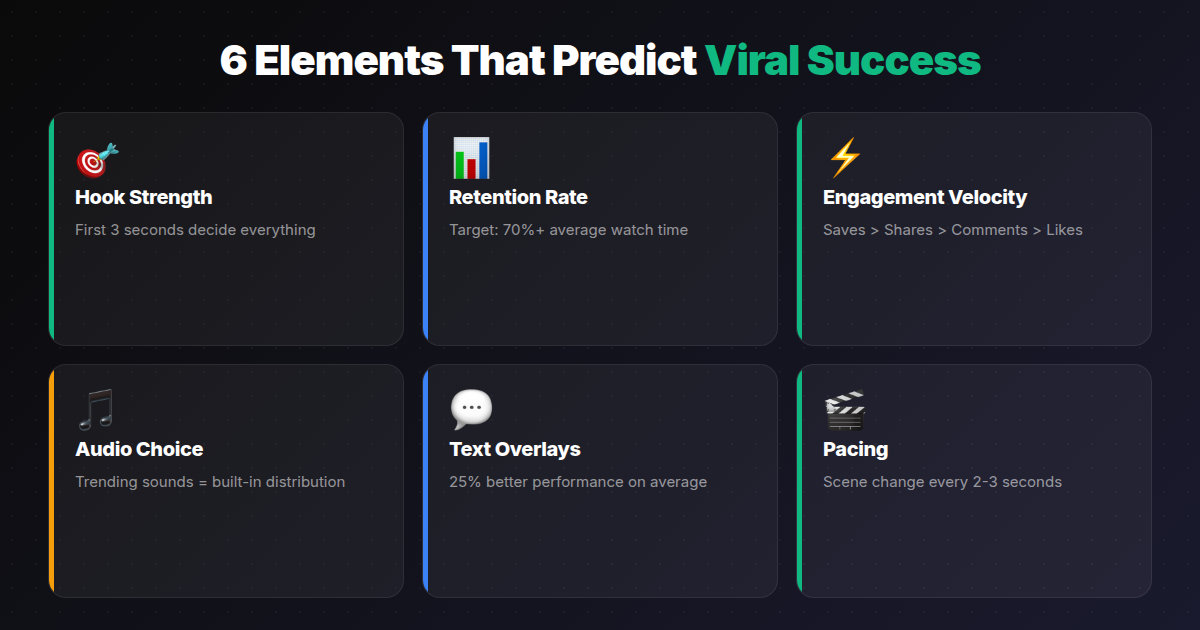
1. Hook Strength (First 3 Seconds)
The hook is everything. If your first 3 seconds don't grab attention, nothing else matters. Use a hook analyzer to test your opening before you commit to publishing.
Strong hooks typically:
- Create curiosity ("Watch what happens when...")
- Make a bold claim ("This changed my life in 24 hours")
- Start mid-action (no intros, no setup)
- Use pattern interrupts (unexpected visuals or sounds)
Weak hook warning signs:
- Starting with "Hey guys" or "So basically"
- Slow fade-ins or title cards
- Explaining what you're about to do instead of doing it
2. Retention Rate
TikTok tracks exactly when viewers drop off. The algorithm loves videos where people:
- Watch until the end
- Rewatch (loop completions)
- Pause to read text overlays
Target: 70%+ average watch time for videos under 60 seconds.
3. Engagement Velocity
How fast people engage matters more than total engagement.
The algorithm weighs:
- Saves (highest weight in 2026)
- Shares (especially off-platform)
- Comments (especially questions like "How?" or "Part 2?")
- Likes (lowest weight, but still counts)
Videos that get engagement in the first 30 minutes get exponentially more distribution.
4. Audio Choice
Using trending sounds isn't random luck. Look for:
- Sounds with thousands of viral videos underneath
- Audio where it's hard to find videos that didn't go viral
- Sounds that match your content's energy
5. Text Overlays & Accessibility
Videos with text overlays perform 25% better on average because:
- People watch on mute
- Text adds another layer of engagement
- It increases watch time (people slow down to read)
6. Pacing
Modern TikTok attention spans are brutal. Your video needs:
- Scene changes every 2-3 seconds
- No dead air
- Constant visual or auditory stimulation
🚀 Pro tip: The Viral Finder Video Analyzer checks all 6 elements automatically — in under 30 seconds.
How to Analyze Your Hook
Your hook has exactly 1.5 seconds to stop the scroll. Here's how to evaluate it:
The Screenshot Test
Take a screenshot of your video at the 1-second mark. Ask yourself:
- Is there movement?
- Is there text?
- Is there a face showing emotion?
- Would YOU stop scrolling?
If you answered "no" to 3+ of these, your hook needs work.
The Sound-Off Test
Watch your first 5 seconds on mute. Does it still make sense? Does it still grab attention?
50%+ of TikTok users scroll with sound off initially. If your hook relies entirely on audio, you're losing half your audience.
The "So What?" Test
State your hook out loud. Then ask: "So what? Why should I care?"
If you can't answer that in one sentence, your hook isn't clear enough.
💡 Pro tip: The best hooks create an "open loop" — they start a story or question that can only be answered by watching the rest of the video.
Watch Time and Retention
Watch time is the single most important metric for the TikTok algorithm in 2026.
Here's how to predict it:
Retention Curve Analysis
Every video has a retention curve — a graph showing when viewers drop off.
Healthy retention curve: Gradual decline, with a spike at the end (people rewatching)
Unhealthy retention curve: Sharp drop in first 3 seconds, continued decline
Red Flags That Kill Retention
- Long intros (anything over 2 seconds)
- Repetitive content (same shot for too long)
- Unclear payoff (viewers don't know what they're waiting for)
- Bad audio quality (instant scroll trigger)
How to Improve Retention
- Front-load the value (give the best stuff first)
- Add "pattern interrupts" every 3-5 seconds
- Use text overlays to keep eyes on screen
- End with a cliffhanger or callback to the beginning
The Free Tool That Does This For You
Here's the thing: manually analyzing all these elements is time-consuming. You'd need to:
- Review your hook frame-by-frame
- Predict retention based on pacing
- Check audio trends
- Evaluate text placement
- Compare against viral benchmarks
Or you could use AI to do it in 30 seconds.
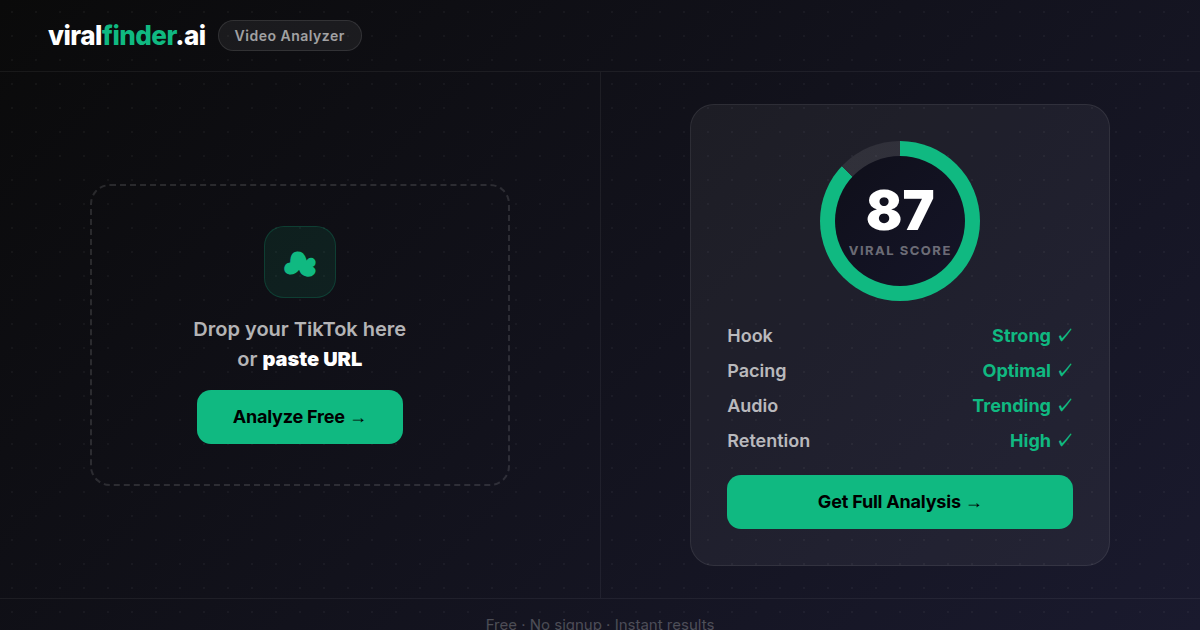
Viral Finder's Free Video Analyzer does exactly this:
- Upload your video (or paste a TikTok URL)
- Get an instant Viral Score (0-100)
- See exactly what's working and what's not
- Get specific suggestions for improvement
The AI analyzes your content across all critical dimensions:
- ✅ Hook effectiveness
- ✅ Pacing and retention predictors
- ✅ Audio optimization
- ✅ Text overlay placement
- ✅ Overall viral potential
The best part? It's free. No signup required for your first analysis.
Step-by-Step: Analyzing Your TikTok Before Posting
Here's the exact process I use before posting any TikTok:
Step 1: Self-Review (2 minutes)
Watch your video 3 times:
- First time: as a viewer (would you stop scrolling?)
- Second time: sound off (does it work visually?)
- Third time: focus only on the first 3 seconds (is the hook strong?)
Step 2: AI Analysis (30 seconds)
Upload your video to Viral Finder's Video Analyzer and get:
- Viral Score prediction
- Hook analysis
- Specific improvement suggestions
Step 3: Fix the Weak Points (5-15 minutes)
Based on the analysis:
- Re-edit your hook if score is below 70
- Add text overlays if retention prediction is low
- Change audio if it's not trending
Step 4: Final Check
Run the improved version through the video analyzer again. Aim for:
- Viral Score: 75+
- Hook Score: 8/10+
- No critical issues flagged
Step 5: Post with Confidence
Now you're not guessing. You know your video has the elements that the algorithm rewards.
Common Mistakes to Avoid
Mistake #1: Posting Without Testing
Every video is a gamble. But now you can stack the odds in your favor. Analyzing before posting takes 2 minutes and can save you from wasting a good content idea on poor execution.
Mistake #2: Ignoring the Data
If the analyzer says your hook is weak, don't post anyway hoping it'll work. Fix it. The algorithm doesn't make exceptions.
Mistake #3: Over-Optimizing
Analysis is a tool, not a prison. If your video scores 65 but feels authentic and true to your brand, post it. The data guides — it doesn't dictate.
Mistake #4: Only Analyzing Failures
Don't just analyze videos that flopped. Analyze your hits too. Understanding why something worked is just as valuable as understanding why it didn't.
The Bottom Line
The difference between a video that gets 500 views and one that gets 500,000 views often comes down to small, fixable details:
- A weak hook that could be stronger
- Pacing that drops off mid-video
- Missing text overlays
- Suboptimal audio choice
You can keep guessing. Or you can analyze your TikTok before posting and know exactly what to fix.
The tools exist. The data is available. The only question is whether you'll use them. Learn more about optimizing your content strategy at the TikTok Creator Portal.
🛠️ Free Tool Mentioned in This Post
Video Analyzer — Upload any TikTok, Reel, or Short and get an instant AI-powered analysis with viral score, hook breakdown, and improvement suggestions. Free, no signup required.
📚 Related Posts
- TikTok Hook Examples: 50 Viral Openers You Can Steal
- Why Your TikToks Aren't Getting Views
- The TikTok Algorithm in 2026: What Actually Matters
- How to Write a TikTok Hook That Stops the Scroll
Written by the Viral Finder team — AI-powered tools for content creators with 35M+ followers.
Last updated: February 2026
Share this article:
Get weekly viral content tips
Join creators who use data to grow faster. Free tips, strategies, and insights in your inbox.
No spam. Unsubscribe anytime.
How viral is your video?
Paste a TikTok, YouTube, or Instagram link and get an AI viral score 0-100 — with detailed feedback on hook, pacing, and engagement. Free, no signup.
Analyze my video →Try our other free tools