The Psychology of Viral Hooks: Why Some Stop the Scroll
The neuroscience behind viral hooks. Learn the 6 psychological triggers that capture attention and how to use them in your content.
The science behind attention capture — and how to use it.
Every scroll is a decision. Every stop is a reaction.
Understanding why people stop scrolling isn't creative guesswork — it's neuroscience. The brain follows predictable patterns when processing content, and viral hooks exploit these patterns systematically.
This guide breaks down the psychology behind hooks that work, so you can engineer attention instead of hoping for it.
<video src="https://s3.us-east-1.amazonaws.com/remotionlambda-useast1-k5qomcb1pb/renders/8xzrpyu8v5/out.mp4" controls playsinline style="width:100%;border-radius:12px;margin:24px 0;"></video>
Table of Contents
- How the Brain Processes Content
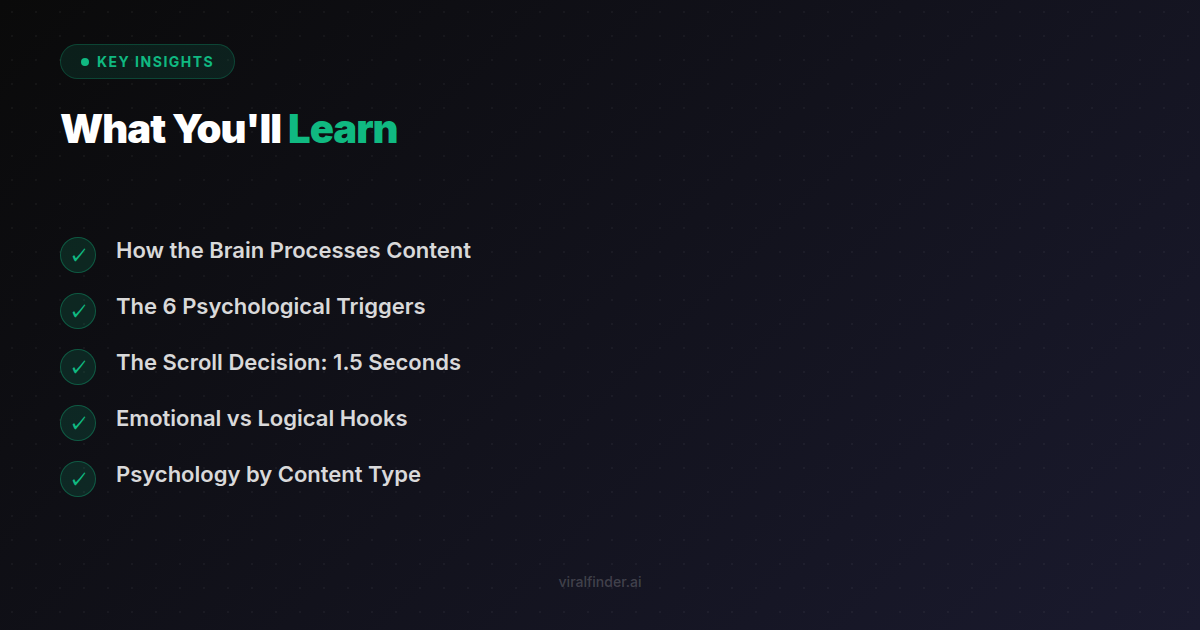
- The 6 Psychological Triggers
- The Scroll Decision: 1.5 Seconds
- Emotional vs Logical Hooks
- Psychology by Content Type
- Applying Psychology to Your Hooks
How the Brain Processes Content {#how-brain-processes}
The Two-System Model
Your brain has two processing systems:
System 1: Fast, Automatic, Emotional
- Operates in milliseconds
- Pattern recognition
- Emotional reactions
- Makes the scroll/stop decision
System 2: Slow, Deliberate, Logical
- Takes seconds to engage
- Analytical thinking
- Conscious evaluation
- Only activates AFTER System 1 says "stop"
The implication: Your hook must win with System 1. Logic comes later.
The Attention Filter
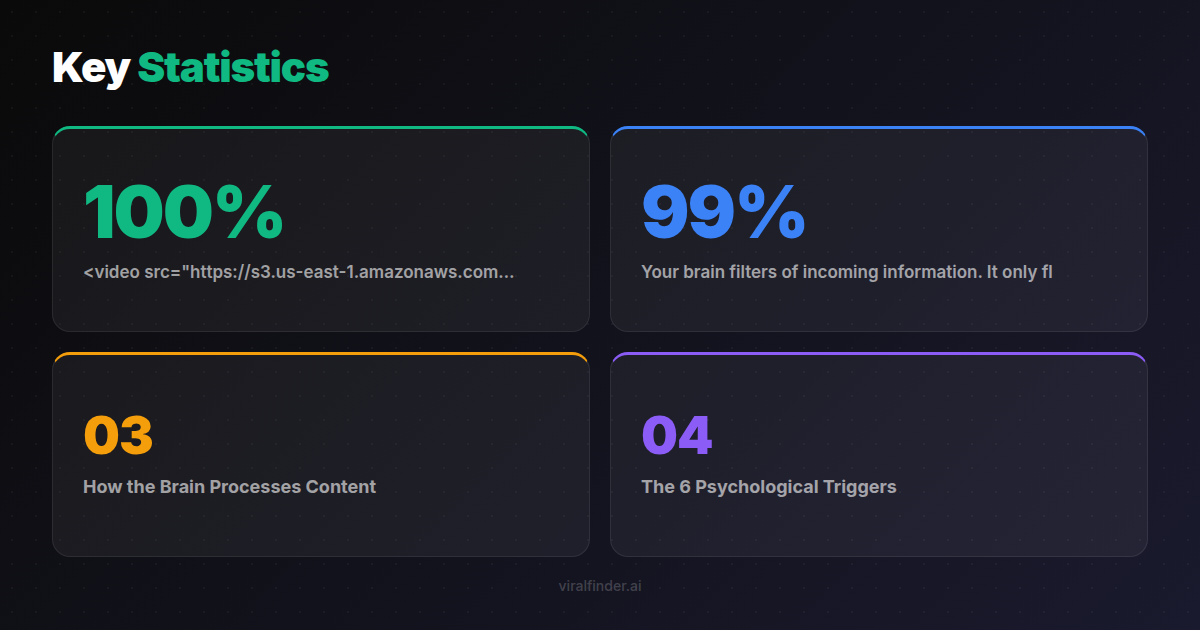
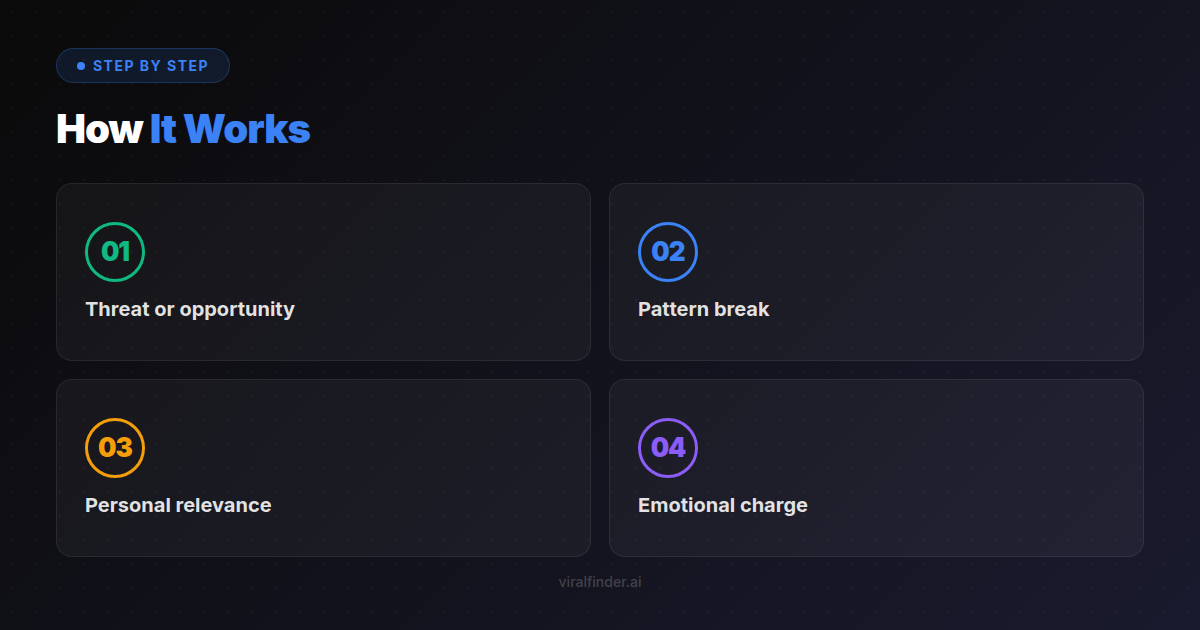
Your brain filters 99% of incoming information. It only flags content that signals:
- Threat or opportunity — Survival instinct
- Pattern break — Something unexpected
- Personal relevance — "This is about me"
- Emotional charge — Strong feeling detected
Viral hooks trigger at least two of these simultaneously.
The 6 Psychological Triggers {#6-triggers}
Trigger #1: Curiosity Gap
What it is: An open loop — information that's incomplete.
Why it works: The brain hates unresolved tension. It's called the Zeigarnik Effect — we remember incomplete tasks better than completed ones. An open loop creates psychological discomfort that can only be resolved by watching.
Example: "The one thing successful people do that you probably don't"
The gap: What's the thing? The brain needs closure.
Trigger #2: Self-Relevance
What it is: Content that feels personally about the viewer.
Why it works: The brain has a "self-relevance detector" that prioritizes information about ourselves. When content feels personal, attention spikes.
Example: "If you've ever felt like you're working hard but getting nowhere, watch this"
The relevance: Viewer self-identifies with the struggle.
Trigger #3: Novelty
What it is: Something unexpected, new, or different.
Why it works: The brain is wired to notice novelty — it could be opportunity or threat. Novel stimuli trigger dopamine release, which feels rewarding.
Example: "I tried the opposite of every productivity tip for 30 days"
The novelty: Contrarian approach is unexpected.
Trigger #4: Social Proof / FOMO
What it is: Signals that others find this valuable.
Why it works: Humans are social animals. We use others' behavior as shortcuts for decision-making. If others are watching, it must be worth watching.
Example: "The video everyone's talking about but no one will share"
The proof: "Everyone" suggests social validation.
Trigger #5: Threat Detection
What it is: Information suggesting the viewer is at risk or making a mistake.
Why it works: The amygdala (fear center) processes threats before conscious awareness. Potential loss feels twice as powerful as potential gain (loss aversion).
Example: "You're probably making this mistake every morning without realizing"
The threat: Viewer might be doing something wrong.
Trigger #6: Emotional Contagion
What it is: Emotion visible in the creator that transfers to viewer.
Why it works: Mirror neurons cause us to "feel" emotions we observe. Seeing excitement creates excitement. Seeing shock creates curiosity about what caused it.
Example: Wide-eyed expression "I can't believe this actually worked"
The contagion: Creator's surprise transfers to viewer.
The Scroll Decision: 1.5 Seconds {#scroll-decision}
What Happens in Those 1.5 Seconds
0-500ms: Visual scan
- Face detected? (humans prioritize faces)
- Motion present?
- High contrast?
- Text readable?
500ms-1s: Pattern recognition
- Is this familiar or novel?
- Does this match my interests?
- Is there emotional signal?
1s-1.5s: Decision
- Stay: Multiple triggers activated
- Scroll: No compelling reason to stay
Optimizing for Each Phase
Phase 1 (Visual):
- Strong facial expression in frame 1
- Movement already happening
- High contrast visuals
- Large, readable text
Phase 2 (Pattern):
- Novel angle or approach
- Clear niche signals
- Emotional tone visible
Phase 3 (Decision):
- Curiosity gap established
- Value implied
- No reason to leave
Test your hook with Hook Analyzer to see if it passes the 1.5-second test.
Emotional vs Logical Hooks {#emotional-vs-logical}
Emotional Hooks
Best for: Entertainment, stories, personal content, broad audiences
Triggers used: Curiosity, novelty, emotional contagion, threat
Example: "This is the scariest thing that ever happened to me"
Why it works: Pure System 1 activation. Emotion is immediate.
Logical Hooks
Best for: Educational content, tutorials, niche audiences
Triggers used: Self-relevance, curiosity gap, threat detection
Example: "3 Excel formulas that will save you 10 hours a week"
Why it works: Specific value proposition for specific audience.
Hybrid Hooks (Most Effective)
Combine emotion + logic:
"I wasted 5 years doing [thing] wrong. Here's what I wish I knew."
- Emotional: "Wasted 5 years" creates empathy/fear
- Logical: "What I wish I knew" promises practical value
Hybrid hooks capture broader audiences and perform more consistently.
Psychology by Content Type {#psychology-by-content}
Entertainment Content
Primary trigger: Novelty + Emotional contagion Hook approach: Start with visible emotion, promise unexpected outcome
Educational Content
Primary trigger: Self-relevance + Curiosity gap Hook approach: Identify problem, tease solution
Story Content
Primary trigger: Curiosity gap + Emotional contagion Hook approach: Start mid-action, show emotional stakes
Opinion Content
Primary trigger: Threat detection + Social proof Hook approach: Challenge existing belief, imply others are wrong
Review/Test Content
Primary trigger: Curiosity gap + Novelty Hook approach: Promise verdict on something people wonder about
Applying Psychology to Your Hooks {#applying-psychology}
The Hook Construction Process
Step 1: Identify your content's core value What does the viewer get from watching?
Step 2: Choose 2-3 psychological triggers Which triggers fit your content naturally?
Step 3: Construct hook using triggers Write multiple versions emphasizing different triggers
Step 4: Test with Hook Analyzer Analyze your hook to see which psychological elements are present
Step 5: Optimize based on feedback Strengthen weak triggers, remove friction
Example Construction
Content: Tutorial on fixing slow iPhone
Core value: Faster phone with simple steps
Triggers chosen:
- Threat detection (your phone is slow because...)
- Self-relevance (you're probably doing this)
- Curiosity gap (one setting that...)
Hook options:
- "Your iPhone is slow because of one setting you've never touched"
- "Apple doesn't want you to know this iPhone speed trick"
- "I fixed my slow iPhone in 30 seconds with this"
Test all three. Data beats intuition.
The Psychology Checklist
Before posting, verify your hook has:
- At least 2 psychological triggers active
- System 1 appeal (emotional/fast processing)
- Clear within 1.5 seconds
- Visual element supporting the hook
- No friction or confusion
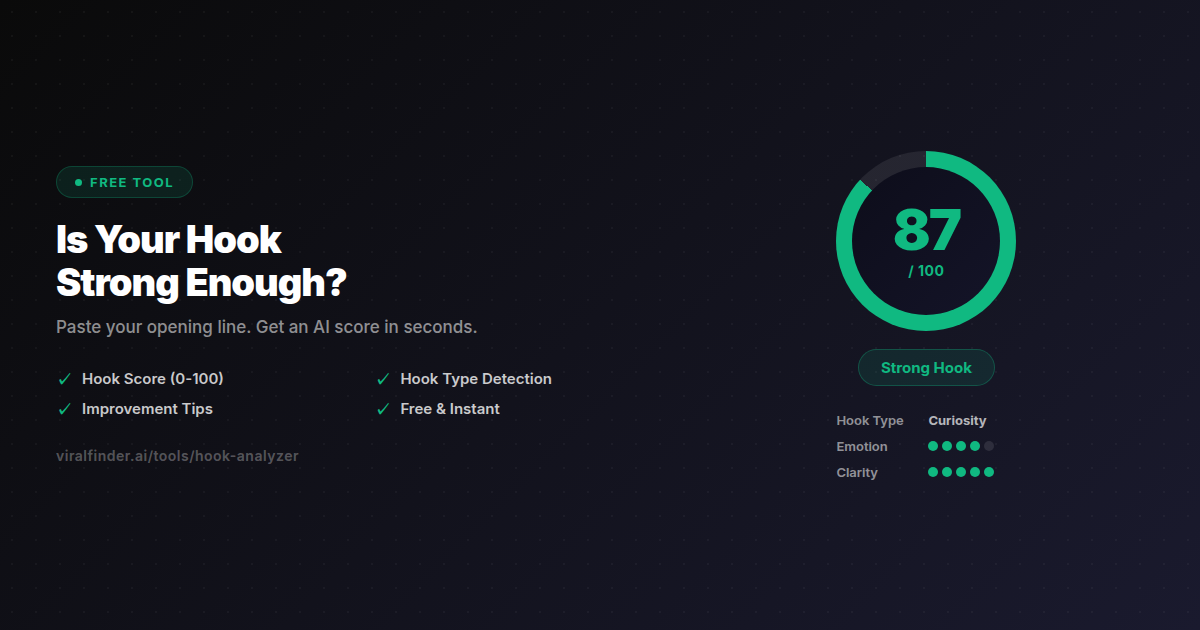
Psychology Meets Data
Understanding psychology gives you the framework. But testing gives you certainty.
- Identify which triggers your hook activates
- See psychological strength score
- Get suggestions to add missing triggers
- Compare against viral benchmarks
Stop hoping your hook works. Know it works.
🛠️ Analyze Your Hook's Psychology
Hook Analyzer — See which psychological triggers your hook activates. Free, instant.
📚 Related Posts
- 15 Hook Formulas That Get Millions of Views
- The First 3 Seconds: What Makes a Viral Hook
- 7 Hook Mistakes That Kill Your Views
Share this article:
Get weekly viral content tips
Join creators who use data to grow faster. Free tips, strategies, and insights in your inbox.
No spam. Unsubscribe anytime.
Is your hook strong enough?
Paste your opening line and get an instant AI score — hook strength, type, and how to make it better. Free, no signup.
Analyze my hook →Try our other free tools