The First 3 Seconds: What Makes a Viral TikTok Hook (2026)
Learn the psychology and mechanics behind viral TikTok hooks. The 5 elements every hook needs, templates you can copy, and how to test before posting.
The psychology and mechanics behind hooks that stop the scroll.
You have exactly 1.5 seconds to convince someone your video is worth watching.
Not 10 seconds. Not 5 seconds. Less than the time it takes to blink twice.
In that moment, the viewer's thumb is hovering over the screen, ready to scroll. Your hook either stops them or you lose them forever.
This guide breaks down exactly what makes a hook work — the psychology, the mechanics, and the framework you can use to create hooks that go viral.
<video src="https://s3.us-east-1.amazonaws.com/remotionlambda-useast1-k5qomcb1pb/renders/cudt6semh7/out.mp4" controls playsinline style="width:100%;border-radius:12px;margin:24px 0;"></video>
Table of Contents
- The Science of Attention
- The 5 Elements of a Viral Hook
- The Hook Framework
- Before & After Examples
- Testing Your Hooks
The Science of Attention {#the-science-of-attention}
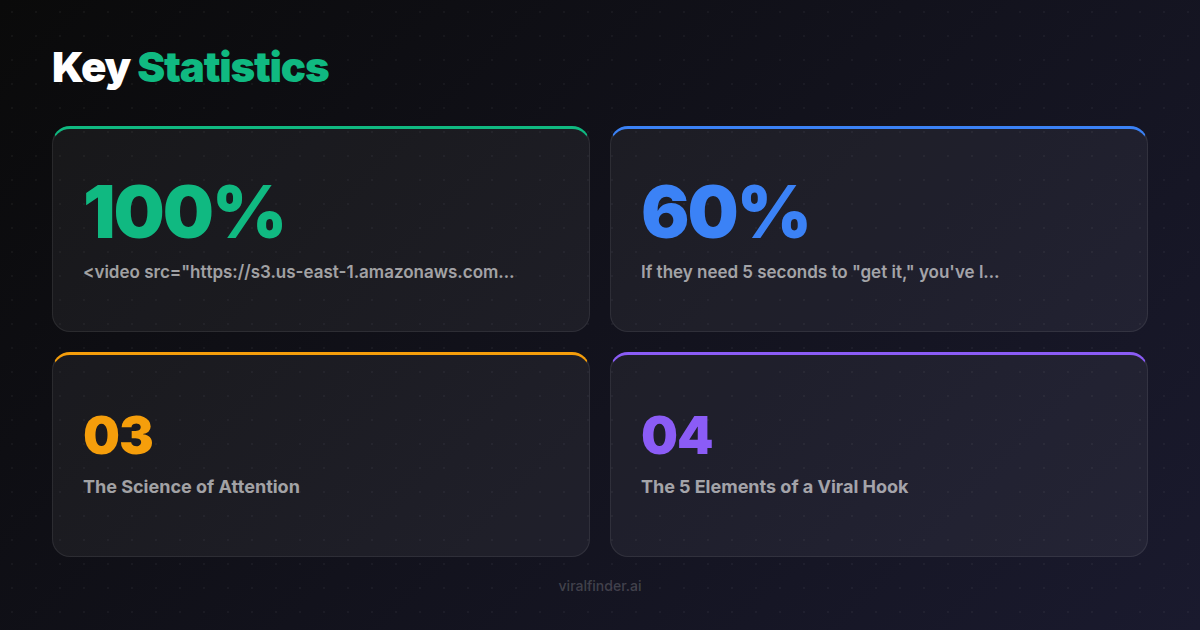
Why 3 seconds? It's not arbitrary — it's biology.
The Scroll Reflex
When someone opens TikTok, they enter a state of continuous partial attention. They're scanning, not watching. Their default behavior is to scroll.
Your hook has to break that pattern.
Research shows that the brain makes a stay-or-go decision in about 1.5 seconds. By the 3-second mark, that decision is final.
What Triggers the "Stop"
The brain stops scrolling when it detects:
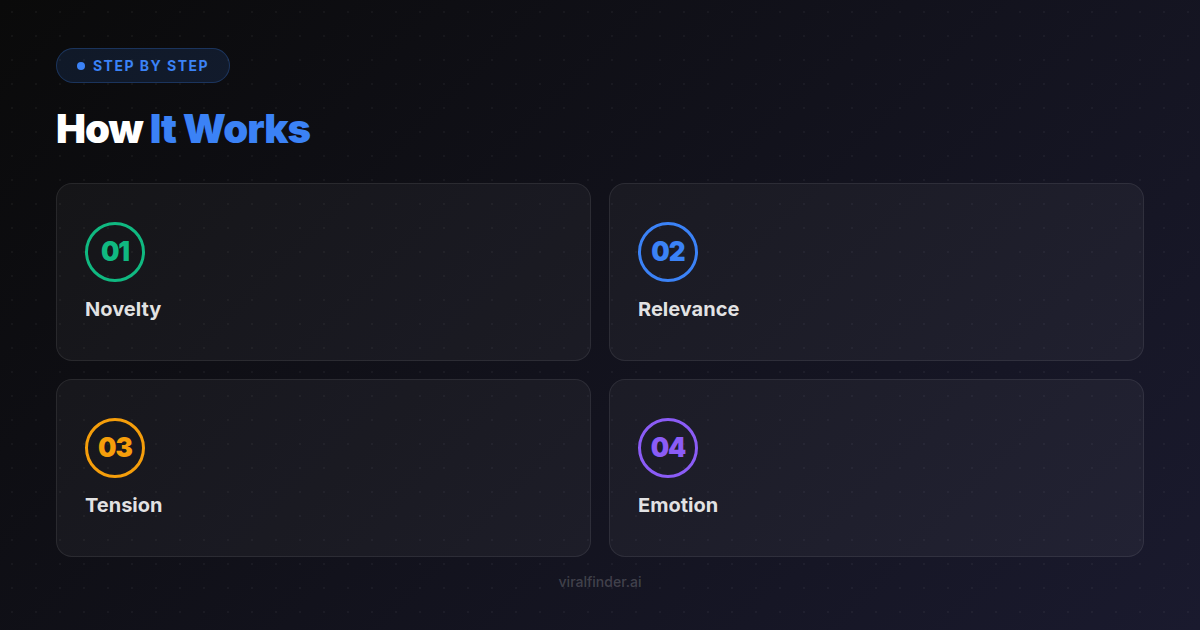
- Novelty — Something unexpected or different
- Relevance — Something personally meaningful
- Tension — An unresolved question or conflict
- Emotion — Strong feeling (positive or negative)
- Motion — Physical movement catches the eye
Great hooks trigger at least 2-3 of these simultaneously.
The Dopamine Factor
TikTok is designed to deliver dopamine hits. Your hook needs to promise one.
The brain thinks: "Will watching this feel good?"
If your hook suggests entertainment, value, surprise, or validation — the brain says yes.
The 5 Elements of a Viral Hook {#the-5-elements}
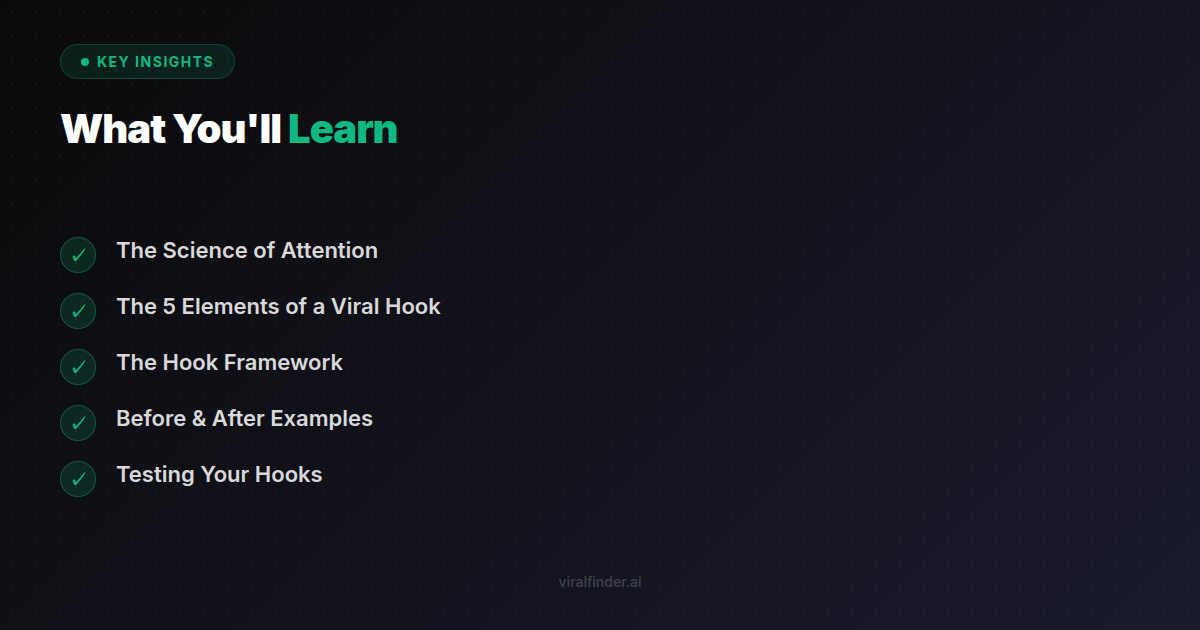
Every viral hook contains at least 3 of these elements:
Element #1: Immediate Visual Interest
What does frame 1 look like? Before any words register, the visual must grab attention.
What works:
- Face showing strong emotion
- Movement already in progress
- Unusual setting or prop
- High contrast visuals
- Text that creates curiosity
What fails:
- Static shot
- Dark or blurry image
- No human element
- Boring background
Element #2: Pattern Interrupt
The brain is constantly predicting what comes next. Break that prediction.
What works:
- Starting mid-sentence
- Unexpected statement
- Visual surprise
- Breaking fourth wall
- Subverting expectations
What fails:
- "Hey guys, welcome back"
- Slow fade-ins
- Title cards
- Explaining what you're about to do
Element #3: Open Loop
Create a question that can only be answered by watching.
What works:
- "You won't believe what happened..."
- "Here's the thing nobody tells you..."
- "Watch till the end to see..."
- Starting a story mid-action
What fails:
- Giving away the conclusion
- No mystery or tension
- Predictable content
Element #4: Emotional Trigger
Make the viewer feel something immediately.
Emotions that work:
- Curiosity
- Surprise
- Recognition ("that's so me!")
- Outrage
- Anticipation
- FOMO
Emotions that fail:
- Boredom
- Confusion
- Indifference
Element #5: Value Promise
Why should they keep watching? What's in it for them?
Value types:
- Entertainment ("this is going to be funny")
- Information ("I'll learn something")
- Transformation ("this could help me")
- Connection ("I relate to this")
- Drama ("I need to see what happens")
💡 Pro tip: The value promise doesn't need to be stated — it can be implied. "Watch me confront my neighbor" implies drama without spelling it out.
The Hook Framework {#the-hook-framework}
Here's a formula you can use for any content type:
The STOP Framework
S — Surprise (pattern interrupt) T — Tension (open loop) O — Ownership (relevance to viewer) P — Promise (implied value)
Example breakdown:
"Nobody talks about this, but your morning routine is destroying your productivity"
- Surprise: "Nobody talks about this" — implies hidden knowledge
- Tension: "destroying" — strong word that creates concern
- Ownership: "your morning routine" — directly relevant to viewer
- Promise: They'll learn what's wrong and how to fix it
Hook Templates That Work
Template 1: The Insider "[Group] don't want you to know this, but [revelation]"
Template 2: The Challenge "I bet you can't [action] without [reaction]"
Template 3: The POV "POV: You just discovered [life-changing thing]"
Template 4: The Story "This is the [superlative] thing that ever happened to me"
Template 5: The Mistake "Stop doing [common action] — here's why"
Template 6: The Test "Let's see if [thing] actually works"
Template 7: The Confession "I wasn't going to post this, but [reason]"
Before & After Examples {#before-and-after}
Example 1: Cooking Video
Before (weak): "Hey everyone! Today I'm going to show you how to make pasta."
After (strong): "This $2 pasta trick made my Italian grandmother cry."
Why it's better:
- Specific claim ($2)
- Emotional stake (grandmother crying)
- Curiosity (what's the trick?)
Example 2: Life Advice
Before (weak): "In this video, I want to talk about productivity tips."
After (strong): "The productivity advice everyone gives is actually making you less productive."
Why it's better:
- Contrarian take
- Challenges existing belief
- Creates need to understand
Example 3: Product Review
Before (weak): "Today I'm reviewing this new skincare product."
After (strong): "I've been lying to you about my skin. This is what actually fixed it."
Why it's better:
- Personal confession
- Creates intrigue ("lying")
- Promises real solution
Example 4: Tutorial
Before (weak): "Here's how to edit videos on your phone."
After (strong): "I edited this video in 3 minutes on my phone. Here's exactly how."
Why it's better:
- Specific claim (3 minutes)
- Proves the result (this video)
- Clear value
Testing Your Hooks {#testing-your-hooks}
The Self-Test
Before posting, ask yourself:
- Would I stop scrolling? Be honest.
- Is the first frame interesting? Screenshot it.
- What question does it create? If none, rewrite.
- What emotion does it trigger? If none, rewrite.
- Does it work without sound? Test on mute.
The A/B Test Method
Film your content once, then record 3-5 different hooks. Post the one that tests best.
How to test:
- Show to friends and time their reaction
- Post at different times and compare
- Use the Video Analyzer for AI feedback
The Data Approach
Use Viral Finder's Video Analyzer to:
- Get a hook score (1-10)
- See predicted retention
- Get specific improvement suggestions
- Compare against viral benchmarks
This takes the guesswork out. The AI tells you exactly what's working and what's not.
The 3-Second Rule
Here's the ultimate test:
Can someone understand what your video is about and why they should watch in 3 seconds or less?
If they need 5 seconds to "get it," you've lost 60% of potential viewers.
Strip away everything that isn't essential in those first moments. The setup, the context, the explanation — it can all come later.
The hook's only job is to earn the next 3 seconds.
Common Hook Killers
❌ Starting with "So basically..."
You've already lost. That phrase signals "I'm about to ramble."
❌ Explaining what you're about to do
"In this video, I'm going to show you..." — Just show it.
❌ Asking "What's up?"
Nobody cares. They don't know you yet.
❌ Slow builds
Your video might get better at the 10-second mark. But no one will be there to see it.
❌ Relying only on text
Text hooks can work, but pair them with visual interest.
Make Your Hook Work
Your content could be incredible. But without a strong hook, no one will see it.
Remember:
- 1.5 seconds to stop the scroll
- 3 seconds to secure commitment
- Every millisecond counts
Don't leave it to chance. Test your hook before posting and know exactly whether it'll work.
🛠️ Test Your Hook
Video Analyzer — Upload your video and get instant feedback on your hook's effectiveness.
📚 Related Posts
- TikTok Hook Examples: 50 Viral Openers
- How to Analyze Your TikTok Before Posting
- Video Retention Rate: The Metric That Predicts Virality
Share this article:
Get weekly viral content tips
Join creators who use data to grow faster. Free tips, strategies, and insights in your inbox.
No spam. Unsubscribe anytime.
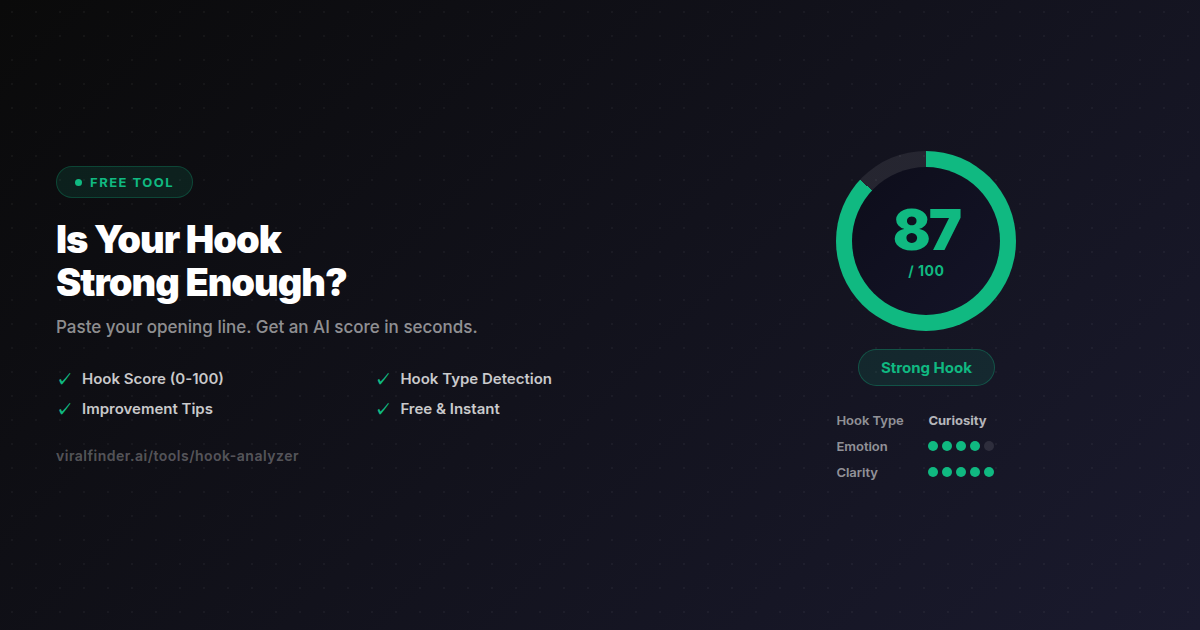
Is your hook strong enough?
Paste your opening line and get an instant AI score — hook strength, type, and how to make it better. Free, no signup.
Analyze my hook →Try our other free tools