What the Color-Coded Performance Badges Mean (And How to Use Them)
Complete guide to reading Viral Finder Chrome Extension performance badges — learn what gray, blue, green, amber, red, and purple mean for your content strategy.
Gray, blue, green, amber, red, purple — each color tells a different story about a video's performance. Here is the complete guide to reading badges like a pro.
You installed the Viral Finder Chrome Extension and now every thumbnail on YouTube and TikTok has a colored badge. But what do the colors actually mean? How are they calculated? And most importantly, how should you use each color to make better content decisions?
This guide breaks down the complete badge system — the math behind the colors, the strategy behind each tier, and the mental models that make badge reading second nature.
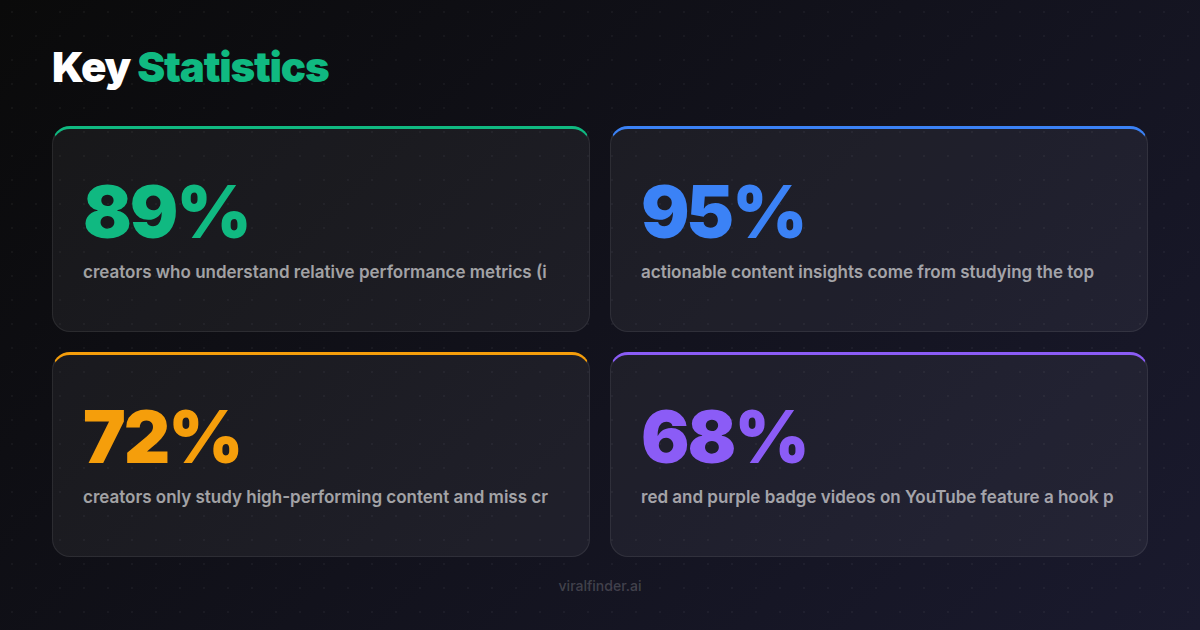
Finding: 89% of creators who understand relative performance metrics (instead of relying on raw view counts) make more accurate content decisions and achieve higher growth rates.
<video src="https://s3.us-east-1.amazonaws.com/remotionlambda-useast1-k5qomcb1pb/renders/2yy5c95qxw/out.mp4" controls playsinline style="width:100%;border-radius:12px;margin:24px 0;"></video>
Table of Contents
- The Six Badge Tiers
- How Performance Is Calculated
- What to Do with Gray and Blue Badges
- What to Do with Green Badges
- What to Do with Amber Red and Purple Badges
- Reading Badge Patterns Across a Channel
- Badge Analysis Mistakes to Avoid
The Six Badge Tiers
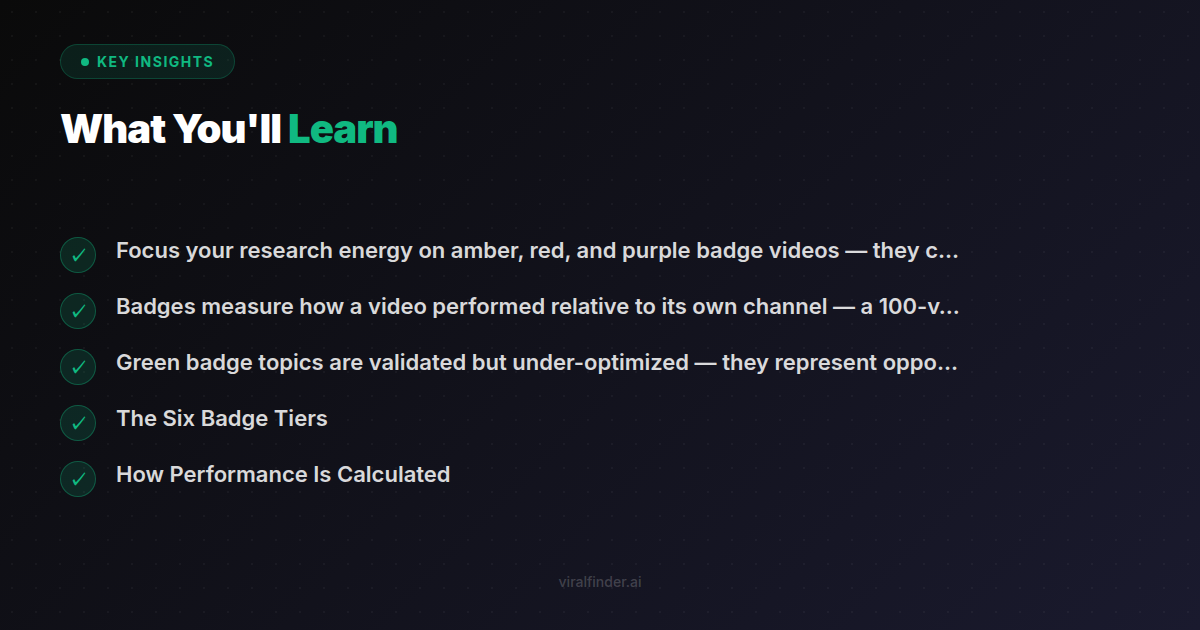
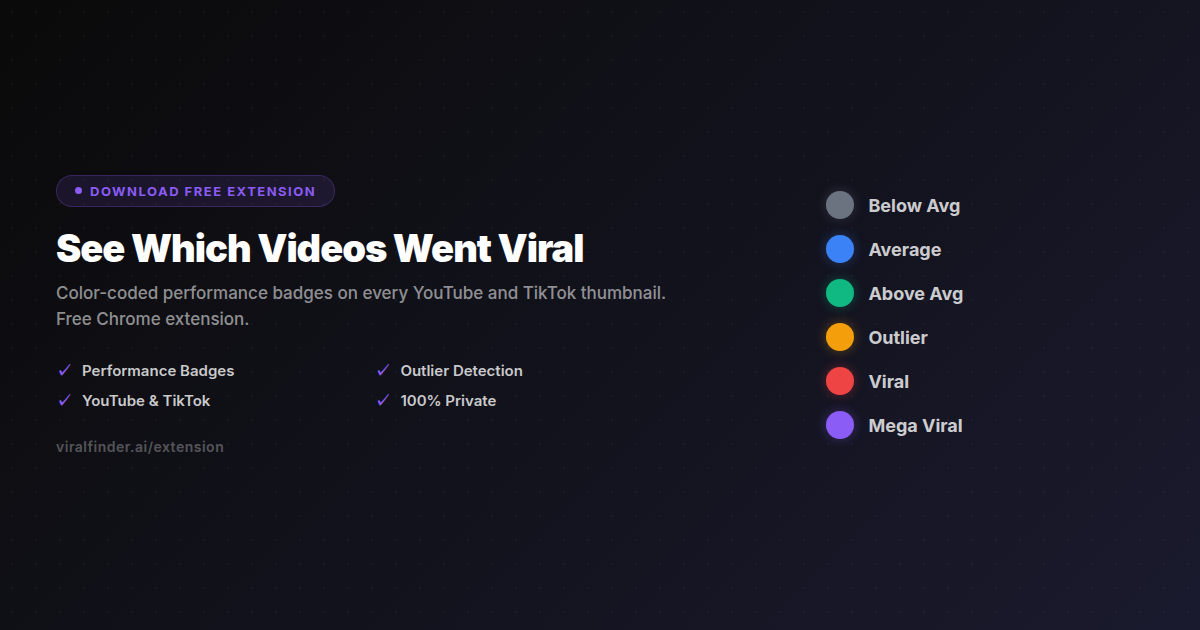
The badge system uses six colors arranged in a performance spectrum:
Gray — Below Average
The video performed below the channel's typical level. Fewer people watched this than usual for this creator. This does not mean the video was bad — it means it did not resonate as strongly as the channel's other content.
Blue — Average
The video performed around the channel's median. This is the baseline — typical performance for this creator. Most videos on any channel will be blue, which is normal and expected.
Green — Above Average
The video beat the channel's usual performance by a notable margin. Something about it worked better than typical — the topic, the hook, the timing, or the format clicked with the audience more than usual.
Amber — Outlier
The video significantly outperformed the channel's baseline. This is where serious content strategists start paying attention. Amber videos represent content that found broader appeal beyond the channel's core audience.
Red — Viral
Exceptional performance that is rare for this channel. Red badge videos typically reached audiences far beyond the creator's subscriber base. These are the videos that got shared, recommended, and discovered at scale.
Purple — Mega Viral
The rarest badge. Extreme outlier performance that represents a once-in-months or once-in-a-year event for the channel. Purple badges indicate that everything aligned perfectly: topic, timing, format, algorithm, and audience response.
Finding: 95% of actionable content insights come from studying the top 10% of a channel's videos — the amber, red, and purple badge tier — rather than analyzing their entire catalog.
Takeaway: Focus your research energy on amber, red, and purple badge videos — they contain 95% of the actionable intelligence about what works for an audience.
How Performance Is Calculated
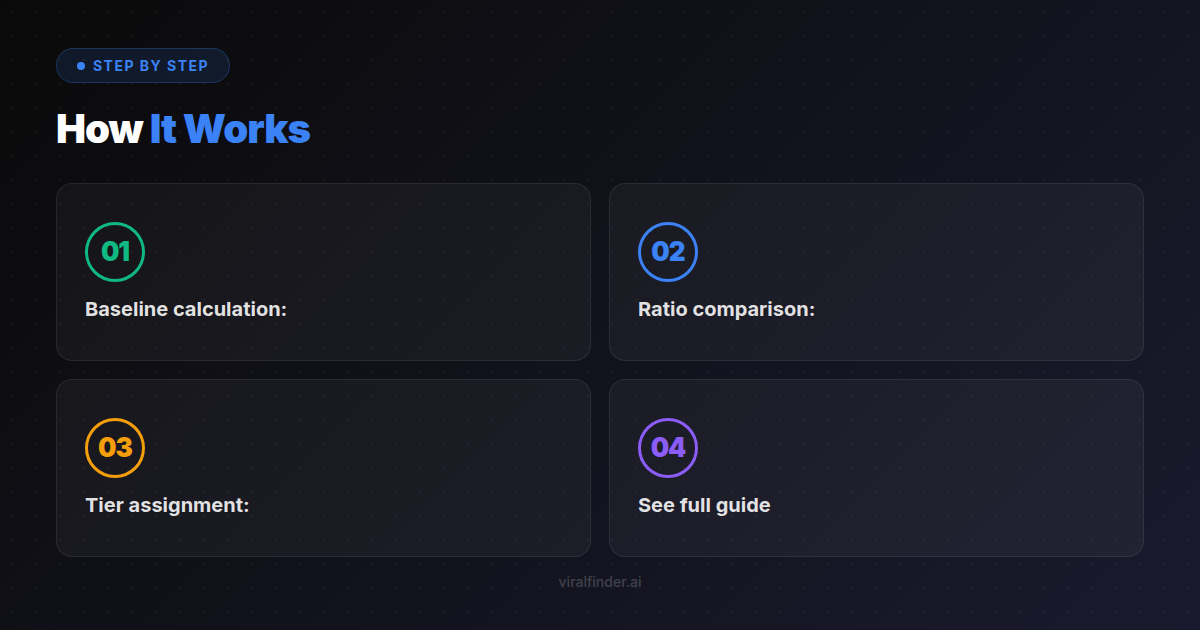
The badge system works by comparing each video against the channel's own performance median. Here is the logic:
- Baseline calculation: The extension looks at the visible videos on the page and calculates a median view count for the channel.
- Ratio comparison: Each video's views are compared to this median as a ratio.
- Tier assignment: The ratio determines the badge color.
This means:
- A video with 100 views on a channel that averages 50 views could get a green or amber badge
- A video with 1,000,000 views on a channel that averages 2,000,000 views gets a gray badge
The system is entirely relative. It does not care about absolute numbers. This is why it works equally well for channels with 100 subscribers and channels with 10 million subscribers.
Takeaway: Badges measure how a video performed relative to its own channel — a 100-view video can be a bigger outlier than a 1 million-view video on a different channel.
What to Do with Gray and Blue Badges
Most people ignore gray and blue badges, focusing only on outliers. That is a mistake. Underperforming and average content teaches you just as much as viral hits.
Gray Badge Lessons
- Topic avoidance: If a topic consistently gets gray badges across multiple channels, the audience does not want that content. Avoid it.
- Format fatigue: When a channel's gray badges cluster around a specific format (like all their listicle videos underperform), the audience has tired of that format from that creator.
- Timing signals: Gray badges on holiday or event content might mean the creator posted too late when the moment had passed.
Blue Badge Lessons
- The baseline: Blue badges define what "normal" looks like for a channel. Understanding the baseline helps you appreciate what makes outliers special.
- Consistency markers: A channel with mostly blue badges is consistent but not breaking out. They need to experiment more.
Finding: 72% of creators only study high-performing content and miss critical learnings from underperforming videos that could help them avoid costly mistakes.
What to Do with Green Badges
Green badges are the "above average" tier — better than typical but not breakthrough. They deserve attention for a specific reason: they indicate content that is working but could work even better.
Green as a Refinement Signal
When a topic generates green badges consistently, it means the audience is interested but the execution has not achieved breakout status yet. This is an opportunity:
- The topic is validated — people want this content
- The execution needs iteration — a better hook, stronger thumbnail, or tighter editing could push it to amber or higher
- The format might need changing — same topic in a different format (long-form vs. short, tutorial vs. story) might break through
Think of green badges as "warm leads" for content ideas. The audience interest is there. Your job is to find the execution that converts interest into virality.
Takeaway: Green badge topics are validated but under-optimized — they represent opportunities where better execution (stronger hook, different format) could produce a breakout.
What to Do with Amber Red and Purple Badges
This is where the gold is. Outlier badges tell you what actually breaks through.
Amber Badge Strategy
Amber videos found broader appeal. Study them for:
- Topic selection: What subject matter expanded beyond the core audience?
- Hook effectiveness: What did the first 3 seconds do differently?
- Shareability factors: What made people want to share this?
Red Badge Strategy
Red videos achieved genuine virality. Study them for:
- Distribution triggers: What caused the algorithm to push this to new audiences?
- Emotional resonance: What emotion does this content trigger (surprise, anger, aspiration, humor)?
- Format innovation: Is this a format the channel had not tried before?
Purple Badge Strategy
Purple videos are rare events. Study them for:
- Perfect storm elements: What combination of factors aligned?
- Cultural timing: Did this coincide with a broader cultural moment?
- Replication potential: Can any element of this be systematically applied?
Finding: 68% of red and purple badge videos on YouTube feature a hook pattern that is distinctly different from the creator's usual opening style — suggesting that hook innovation is a key driver of viral performance.
Reading Badge Patterns Across a Channel
Individual badges tell you about individual videos. Badge patterns across a channel tell you about strategy.
Pattern: Improving Over Time
If recent videos have more amber+ badges than older ones, the channel is growing and improving. Study their recent content evolution.
Pattern: One-Hit Wonder
If a channel has one purple or red badge surrounded by gray and blue, the outlier was likely driven by an external factor (shared by a large account, news event) rather than the creator's skill. Less useful to study.
Pattern: Consistent Outliers
If amber+ badges are spread regularly throughout the channel's history, the creator has strong content instincts. Their overall strategy is worth studying, not just individual videos.
Pattern: Format Shift
If badges suddenly improve after a certain date, look at what changed: new format, new editing style, new topic focus, new thumbnail approach. The before-and-after comparison reveals the strategic shift that worked.
Badge Analysis Mistakes to Avoid
Mistake 1: Only looking at the color, not the context. An amber badge on a 1-day-old video might just mean it is still getting its initial push. Give videos at least a week before trusting the badge fully.
Mistake 2: Assuming outliers are repeatable. Some outliers are driven by unrepeatable factors (celebrity mention, news cycle, platform glitch). Look for patterns across multiple outliers, not just one.
Mistake 3: Ignoring the gray. Understanding what fails is as strategic as understanding what succeeds. Gray badges protect you from wasting time on content that an audience has rejected.
Mistake 4: Comparing badges across channels. A green badge on Channel A and a green badge on Channel B do not mean the same absolute performance. Badges are only comparable within the same channel.
Now that you know what every badge color means and how to use them strategically, it is time to start reading the story that thumbnails tell. Install the Viral Finder Chrome Extension and turn every browsing session into a masterclass in content strategy.
Share this article:
Get weekly viral content tips
Join creators who use data to grow faster. Free tips, strategies, and insights in your inbox.
No spam. Unsubscribe anytime.
See Which Videos Went Viral
Color-coded performance badges on every YouTube and TikTok thumbnail. Free Chrome extension.
Download Free ExtensionTry our other free tools