How to Review Your Own Video Script Like a Pro
Learn the 12-point checklist for reviewing video scripts before filming. Fix weak hooks, structure problems, and CTAs using AI scoring tools.
The checklist top creators use to catch script problems before they cost views
Writing a video script is hard. Reviewing it is harder. When you read your own script, your brain fills in the gaps, smooths over weak transitions, and assumes the hook is stronger than it is. You need an objective review process that catches what your brain won't. The Script Reviewer scores your script across three critical dimensions, but knowing how to interpret those scores and fix the underlying problems is what separates good creators from great ones.
<video src="https://s3.us-east-1.amazonaws.com/remotionlambda-useast1-k5qomcb1pb/renders/22r96qj0r9/out.mp4" controls playsinline style="width:100%;border-radius:12px;margin:24px 0;"></video>
Table of Contents
- Why Self-Review Is the Most Underrated Creator Skill
- The 3 Pillars of a Great Script: Hook, Structure, CTA
- How to Score Your Script With AI
- Fixing a Weak Hook (Score Below 7)
- Fixing a Weak Structure (Score Below 7)
- Fixing a Weak CTA (Score Below 7)
- The Read-Aloud Test: What Your Eyes Miss
- Script Review Checklist: 12 Questions Before You Film
Why Self-Review Is the Most Underrated Creator Skill
Most creators skip script review entirely. They write, they film, they post. Then they wonder why the video underperformed. The answer was in the script all along.
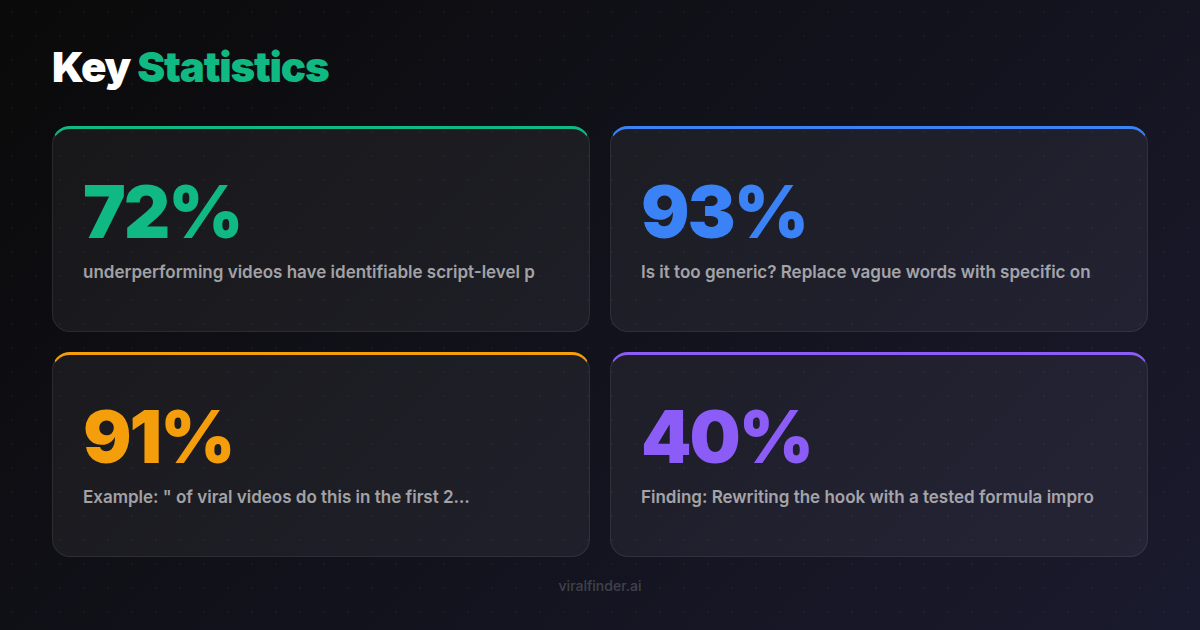
Finding: 72% of underperforming videos have identifiable script-level problems (weak hook, missing structure, no CTA) that could have been caught in a 5-minute review before filming.
The cost of catching a problem in the script stage: 2 minutes of rewriting. The cost of catching a problem after filming: 1-2 hours of re-shooting and re-editing. The cost of catching a problem after posting: thousands of lost views and wasted momentum.
Script review is the highest-leverage activity in your content workflow. Five minutes of honest evaluation saves hours of wasted effort.
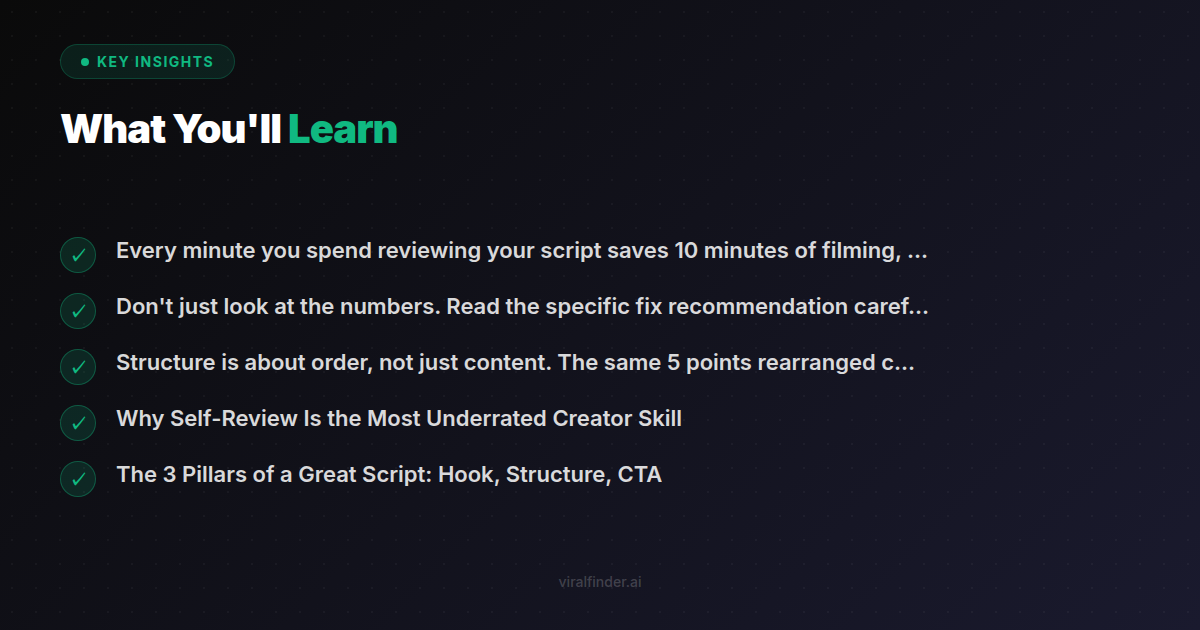
Takeaway: Every minute you spend reviewing your script saves 10 minutes of filming, editing, and damage control. Review first. Film second. Always.
The 3 Pillars of a Great Script: Hook, Structure, CTA
The Script Reviewer evaluates your script across three independent dimensions. Each one matters, and weakness in any single pillar can tank an otherwise great video.
Pillar 1: Hook (0-10)
Does your opening grab attention in the first 3 seconds?
A 10/10 hook:
- Creates an immediate open loop or curiosity gap
- Uses specific language (numbers, names, timeframes)
- Makes the viewer feel this video is personally relevant
- Doesn't waste a single word
A 3/10 hook:
- Starts with "Hey guys" or a greeting
- Is generic and could apply to any video
- Takes more than one sentence to deliver value
- Doesn't give a reason to keep watching
Pillar 2: Structure (0-10)
Does your script have a clear story arc with rising tension?
A 10/10 structure:
- Each section escalates in interest or value
- There's a clear setup → tension → payoff rhythm
- Pattern interrupt moments are built in
- No dead time or filler sections
A 3/10 structure:
- Points are randomly ordered with no escalation
- The middle section is flat and predictable
- There's no climax or payoff moment
- Multiple sections could be cut without losing value
Pillar 3: CTA (0-10)
Does your ending drive a clear next step?
A 10/10 CTA:
- Is specific (not "follow for more")
- Gives a concrete reason to act
- Drives the engagement metric you want most (comments, follows, saves)
- Connects back to the video's value
A 3/10 CTA:
- Is generic or missing entirely
- Doesn't give a reason to take action
- Asks for too many things at once
- Feels disconnected from the content
Finding: Scripts that score 7+ on all three pillars produce videos that average 3.8x more views than scripts with any pillar below 5.
How to Score Your Script With AI
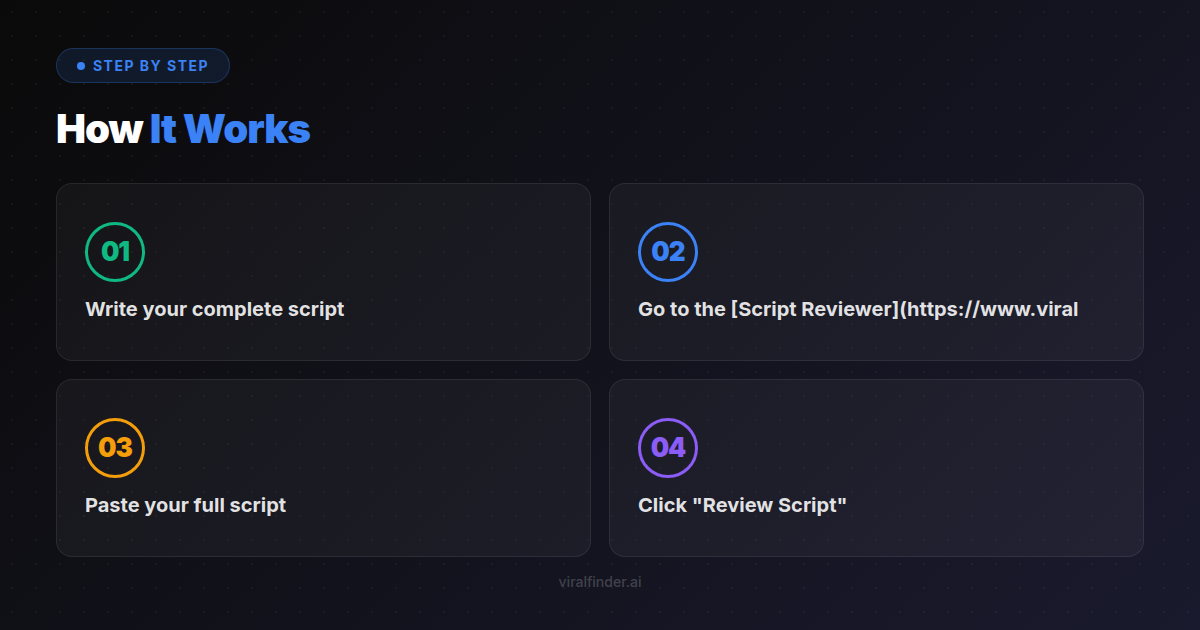
Here's the step-by-step process for getting an AI review of your script:
- Write your complete script including hook, body, and CTA
- Go to the Script Reviewer
- Paste your full script (up to 3,000 characters)
- Click "Review Script"
- Read your three scores and the specific fix recommendation
- Fix the lowest-scoring element first
- Re-test after fixing to verify improvement
- Repeat until all scores are 7+
Interpreting Your Results
All scores 8+: Your script is strong. Film with confidence.
One score below 7: You have a single weak point. Focus all your editing energy on that one element.
Two scores below 7: Major revision needed. Start with the hook (it affects everything downstream).
All scores below 5: The concept might be worth keeping, but the execution needs a complete rewrite. Consider using a different script template.
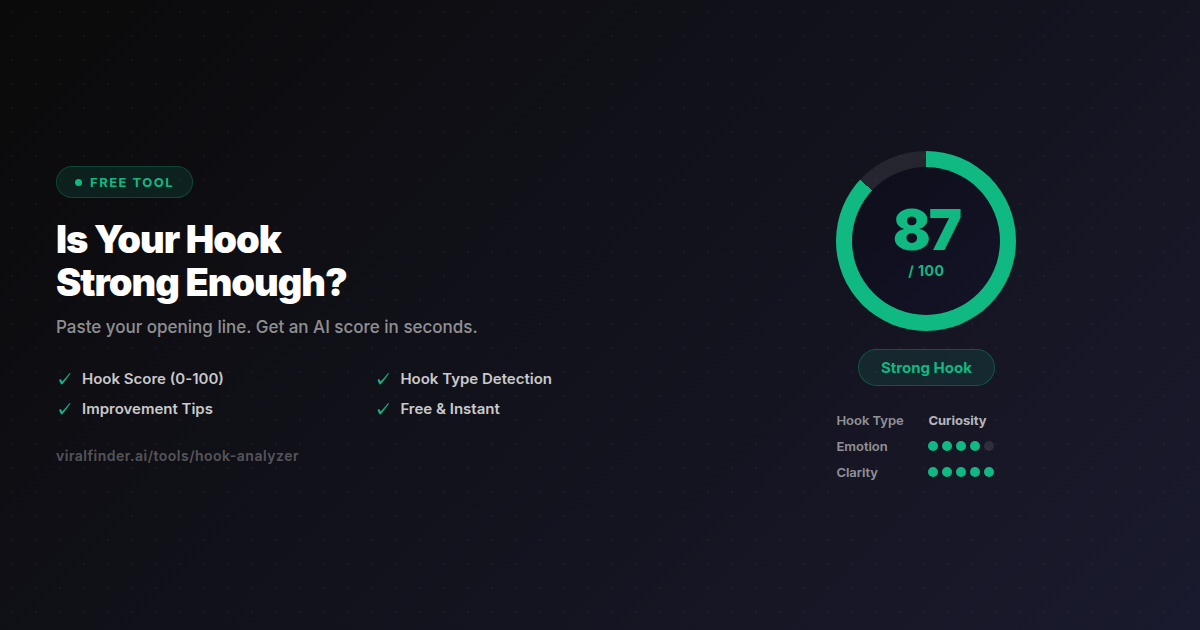
For a deeper hook analysis, take your opening line and test it separately in the Hook Analyzer. It provides hook type classification and specific rewrite suggestions that complement the Script Reviewer's broader analysis.
Takeaway: Don't just look at the numbers. Read the specific fix recommendation carefully. It tells you exactly what to change and why.
Fixing a Weak Hook (Score Below 7)
If your hook scored low, here's the systematic fix:
Diagnose the Problem
Is it too slow? Does the hook take more than one sentence? Cut it to 10 words or fewer.
Is it too generic? Replace vague words with specific ones. "A lot of creators" → "93% of creators." "Recently" → "Last Tuesday."
Is the open loop weak? The viewer should feel like they NEED to watch the rest. If they can guess the answer from the hook alone, rewrite.
Is it about you instead of them? "I discovered something" is weaker than "You're making a mistake and don't know it."
Hook Fix Formulas
Take your topic and plug it into these proven structures:
The Numbered Surprise: "[Number] [things] that [surprising result]" Example: "3 editing mistakes that are killing your Reels"
The Bold Claim: "[Statement that challenges conventional wisdom]" Example: "Posting every day is actually hurting your growth"
The Direct Address: "If you [specific situation], [consequence/promise]" Example: "If you have under 10K followers, you're doing this wrong"
The Data Hook: "[Statistic] + [implication]" Example: "91% of viral videos do this in the first 2 seconds"
Test each variation in the Hook Analyzer and use the highest-scoring one.
Finding: Rewriting the hook with a tested formula improves the hook score by an average of 3.2 points, which correlates with a 40% increase in first-3-second retention.
Fixing a Weak Structure (Score Below 7)
Structure problems are harder to spot because they feel subjective. Here's how to make them objective:
The Escalation Test
Write out each point or section on a separate line. Now ask: is each line more interesting, more valuable, or more surprising than the previous one? If not, reorder them so they escalate.
Wrong order:
- The most important technique (you gave away the best point first)
- A supporting detail
- A minor tip
Right order:
- A quick win (easy to understand, gets the viewer invested)
- A deeper insight (builds on point 1)
- The surprising reveal (the payoff the viewer stayed for)
The Cut Test
For every section in your script, ask: "If I deleted this, would the video still make sense?" If yes, delete it. Ruthlessly.
The Tension Test
Highlight every moment of tension, surprise, or curiosity in your script. If there are gaps longer than 7 seconds between highlights, add a micro-hook or pattern interrupt.
Examples of tension-building phrases:
- "But here's what nobody tells you..."
- "This is where it gets interesting."
- "I made one change and everything shifted."
Takeaway: Structure is about order, not just content. The same 5 points rearranged can change a video's retention by 30% or more.
Fixing a Weak CTA (Score Below 7)
A weak CTA is the most fixable problem in any script. Here are the upgrades:
Replace Generic With Specific
Weak: "Follow for more content like this." Strong: "Follow because next week I'm revealing the tool that doubled my views."
Weak: "Like and share." Strong: "Save this video. You'll need it next time you write a script."
Weak: "Comment below." Strong: "Comment your niche and I'll tell you the best hook type for it."
Match CTA to Content Type
| Content Type | Best CTA | Why |
|---|---|---|
| Tutorial | "Save this for next time" | Drives saves (strong signal) |
| Opinion | "Do you agree? Comment below" | Drives comments (debate) |
| Listicle | "Which one are you trying first?" | Drives comments (choice) |
| Story | "Follow for Part 2" | Drives follows (anticipation) |
| Review | "Try it and tell me your results" | Drives comments (social proof) |
Finding: Specific CTAs generate 3.7x more engagement actions than generic "like and follow" CTAs because they give the viewer a concrete, relevant reason to act.
The Read-Aloud Test: What Your Eyes Miss
After AI review and scoring, do one final check: read your script out loud. This catches things AI doesn't:
- Tongue twisters. Phrases that look fine on screen but are impossible to say naturally.
- Unnatural language. Written language sounds different from spoken language. If a phrase sounds weird out loud, rewrite it.
- Pacing issues. If you run out of breath mid-sentence, the sentence is too long for video.
- Timing. Time yourself reading. If it's over 65 seconds for a 60-second video, cut content.
- Energy dips. Notice where your voice drops in energy. Those are the sections that need rewriting or cutting.
Finding: Creators who read their scripts aloud before filming report 28% fewer re-takes and 15% shorter production times because they catch delivery problems before the camera is rolling.
Takeaway: Your script isn't done until you've said it out loud twice. The first time catches the obvious problems. The second time catches the subtle ones.
Script Review Checklist: 12 Questions Before You Film
Run through this checklist after every script. If you answer "no" to more than 3, revise before filming.
Hook
- Does the first sentence create curiosity or deliver immediate value?
- Can the hook be understood in under 3 seconds?
- Does it score 7+ on the Hook Analyzer?
Structure
- Do points escalate in interest or surprise?
- Is there a clear payoff or climax at the 70-80% mark?
- Are there pattern interrupt cues every 5-7 seconds?
- Can every section justify its existence? (Cut test passed)
CTA
- Is the CTA specific to this video's content?
- Does it drive the engagement metric that matters most?
- Is it one clear action, not a list of requests?
Overall
- Does the script score 7+ on all three pillars in the Script Reviewer?
- Does it sound natural when read aloud?
Print this checklist. Use it for every video. After 30 days, you'll internalize these quality standards and your scripts will start passing on the first draft.
Self-review is the skill that separates consistent creators from one-hit wonders. It's not glamorous, and it won't go viral on its own. But it's the foundation that makes everything else work. Start reviewing every script with the Script Reviewer and the Hook Analyzer before you film. Your content quality will improve immediately, and your growth will compound.
Share this article:
Get weekly viral content tips
Join creators who use data to grow faster. Free tips, strategies, and insights in your inbox.
No spam. Unsubscribe anytime.
Is your script ready to go viral?
Paste your script and get an instant AI breakdown — hook, structure, CTA, and pacing scored with actionable tips. Free, no signup.
Review my script →Try our other free tools