Short-Form Video SEO: How to Get Discovered on TikTok, Reels & Shorts
Learn how to optimize your TikTok, Instagram Reels, and YouTube Shorts for search. Keyword research, hashtag strategy, and SEO tactics that drive consistent views.
The complete guide to making your videos findable through search, not just the algorithm
Most creators rely entirely on the algorithm to distribute their videos. When the algorithm pushes your content, views pour in. When it doesn't, crickets. But there's a second distribution channel that top creators are using to get consistent, predictable views: search. TikTok, Instagram, and YouTube all have powerful search engines, and optimizing your videos for search (SEO) means your content works for you 24/7 instead of dying after 48 hours. The Video Analyzer includes SEO optimization suggestions as part of its analysis to help you rank for the terms your audience is searching.
<video src="https://s3.us-east-1.amazonaws.com/remotionlambda-useast1-k5qomcb1pb/renders/pq0u4iccos/out.mp4" controls playsinline style="width:100%;border-radius:12px;margin:24px 0;"></video>
Table of Contents
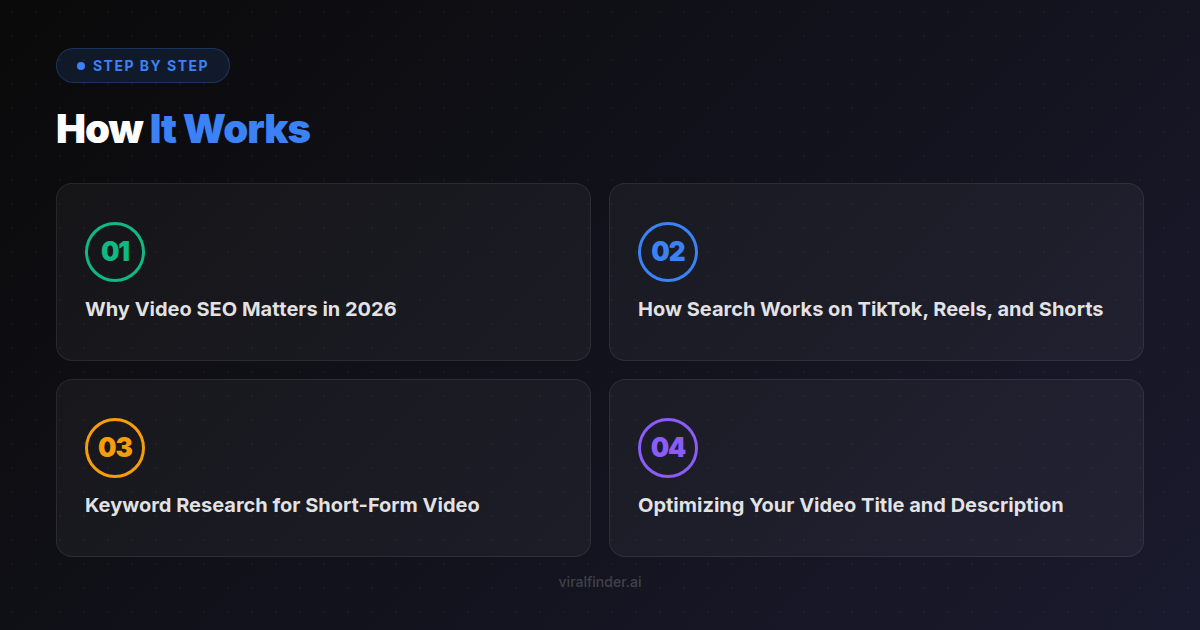
- Why Video SEO Matters in 2026
- How Search Works on TikTok, Reels, and Shorts
- Keyword Research for Short-Form Video
- Optimizing Your Video Title and Description
- Hashtag Strategy: What Actually Works
- On-Screen Text and Spoken Keywords
- Evergreen vs. Trending: Balancing Your Content Mix
Why Video SEO Matters in 2026
The algorithm is unpredictable. You can post the same quality content two days in a row and get 500K views one day and 2K the next. SEO-optimized content doesn't have this problem because search traffic is consistent and compounding.
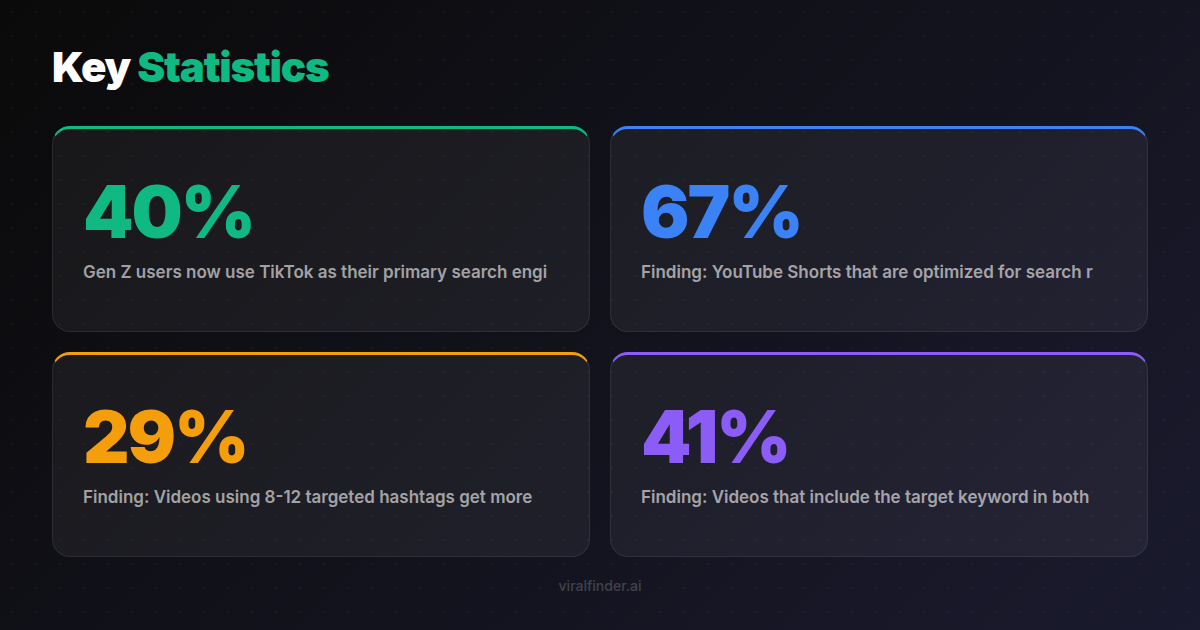
Finding: 40% of Gen Z users now use TikTok as their primary search engine, surpassing Google for product discovery, how-to queries, and local recommendations.
This shift means TikTok isn't just a social media platform anymore. It's a search engine with a video-first interface. And just like Google, the creators who understand SEO get found by people actively looking for their content.
The difference between algorithmic and search traffic:
| Factor | Algorithmic Traffic | Search Traffic |
|---|---|---|
| Predictability | Low (varies daily) | High (consistent) |
| Lifespan | 24-48 hours | Months to years |
| Intent | Passive (scrolling) | Active (searching) |
| Competition | Everyone on the platform | Only videos targeting that keyword |
| Growth type | Spikes | Compound |
Finding: Videos optimized for search continue generating views for an average of 8 months after posting, compared to 2-3 days for algorithm-only videos.
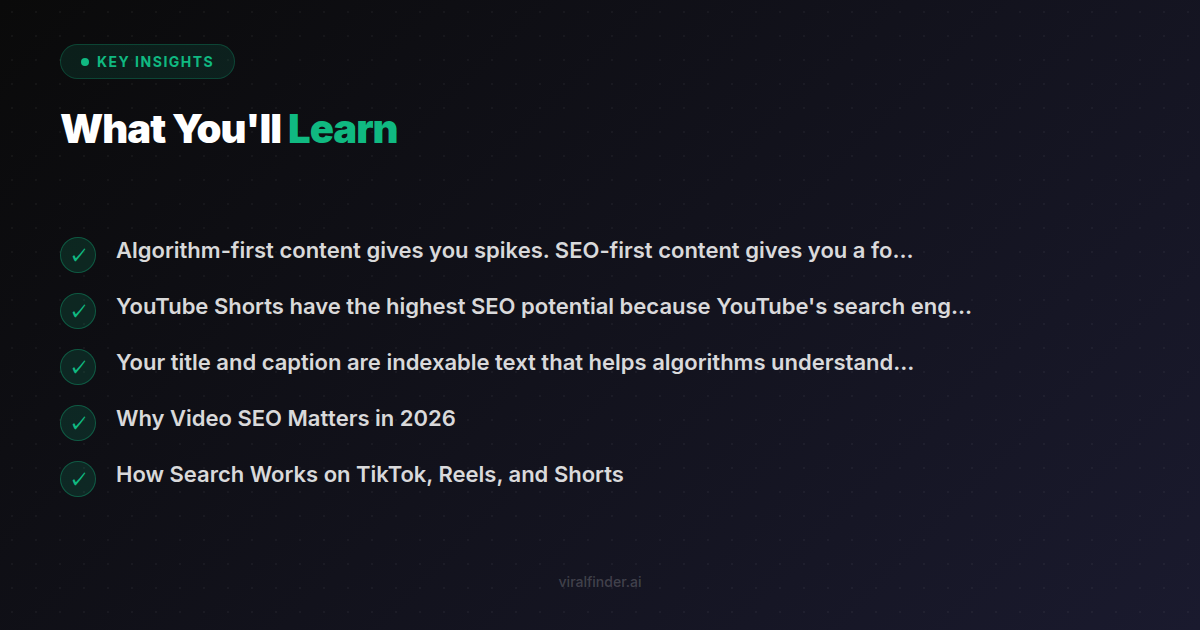
Takeaway: Algorithm-first content gives you spikes. SEO-first content gives you a foundation. The best strategy combines both.
How Search Works on TikTok, Reels, and Shorts
Each platform's search engine works slightly differently:
TikTok Search
TikTok indexes: captions, on-screen text, spoken words (via auto-transcription), hashtags, sounds, and account bio. Its search algorithm heavily weights recent engagement signals, so newer videos with strong retention rank higher for competitive terms.
Instagram Reels Search
Instagram indexes: captions, hashtags, account name, and alt text. It also uses visual recognition to understand what's shown in the video. Reels search is closely tied to Explore page algorithms.
YouTube Shorts Search
YouTube has the most sophisticated search engine of the three. It indexes: title, description, tags, auto-generated captions, channel name, and engagement metrics. YouTube Shorts benefit from the same SEO infrastructure as long-form YouTube videos.
Finding: YouTube Shorts that are optimized for search receive 67% of their views from search and suggested sources after the first 30 days, compared to only 12% for non-optimized Shorts.
Takeaway: YouTube Shorts have the highest SEO potential because YouTube's search engine is the most mature. If you're only on TikTok, you're missing the platform where SEO works best for short-form.
Keyword Research for Short-Form Video
You don't need expensive SEO tools. Here's how to find the keywords your audience is actually searching for:
TikTok Keyword Research
- Open TikTok search and type your topic
- Look at the autocomplete suggestions (these are real searches)
- Search each suggestion and note the view counts on top results
- Prioritize keywords where top results have under 1M views (less competition)
YouTube Shorts Keyword Research
- Go to YouTube search and type your topic
- Note autocomplete suggestions
- Filter results by "Shorts" to see short-form competition
- Look for keywords where top Shorts have under 500K views
Instagram Keyword Research
- Use Instagram's search bar and note autocomplete suggestions
- Check hashtag volumes for related terms
- Look at what hashtags top creators in your niche use consistently
The Keyword Sweet Spot
Target keywords that are:
- Specific enough that you can rank (not just "fitness" but "home workout no equipment")
- Searched often enough to drive traffic (autocomplete = sufficient volume)
- Relevant to your content (don't keyword stuff topics you don't cover)
Finding: Long-tail keywords (3-5 words) drive 2.7x more search traffic per video than broad single-word keywords because competition is lower and intent is clearer.
Optimizing Your Video Title and Description
Title Optimization (YouTube Shorts)
- Include your primary keyword in the first 40 characters
- Use numbers when possible ("5 Ways to..." ranks better than "Ways to...")
- Match search intent (if people search "how to," start your title with "How to")
- Keep it under 60 characters to avoid truncation
Caption Optimization (TikTok and Reels)
- Put your primary keyword in the first line of the caption
- Write 2-3 sentences that naturally include secondary keywords
- End with a CTA that includes a relevant keyword phrase
- Don't stuff keywords unnaturally (the algorithm detects this)
Description Best Practices (All platforms)
- Write for humans first, search engines second
- Include 2-3 keyword variations naturally
- Add context that helps the algorithm categorize your content
- Include a CTA that drives engagement (comments boost search ranking)
Run your finished video through the Video Analyzer to check if your SEO elements are optimized alongside your hook, structure, and retention.
Takeaway: Your title and caption are indexable text that helps algorithms understand your video. Every video should target at least one specific keyword phrase.
Hashtag Strategy: What Actually Works
Hashtags are the most misunderstood SEO element in short-form video. Here's the data-backed approach:
What Doesn't Work
- Using 30 random hashtags (Instagram penalizes this)
- Only using broad hashtags like #fyp #viral #trending (too competitive, zero targeting)
- Copying the same hashtag set for every video (signals lazy content)
What Works
The 3-5-2 Formula:
- 3 niche hashtags (your specific topic: #tiktokscriptwriting, #reelshookformula)
- 5 medium hashtags (your broader category: #contentcreator, #videotips, #socialmediamarketing)
- 2 trending hashtags (only if genuinely relevant to your content)
Finding: Videos using 8-12 targeted hashtags get 29% more discoverability than videos using fewer than 5 or more than 20 hashtags.
Platform-Specific Hashtag Rules
TikTok: 3-5 hashtags in the caption. Mix niche + medium. Skip #fyp (it does nothing).
Instagram Reels: 5-10 hashtags. Can go in caption or first comment. Niche hashtags outperform broad ones.
YouTube Shorts: Hashtags are less important. Focus on title and description keywords instead. Use 2-3 max in the description.
On-Screen Text and Spoken Keywords
This is the SEO secret most creators miss. Platforms transcribe your audio and read your text overlays. Both are used for search indexing.
Spoken Keywords
When you say your target keyword out loud in the video, TikTok's auto-transcription picks it up and indexes it. This is why videos where creators say "how to write a TikTok script" rank for that search term even without perfect captions.
Practical tip: Naturally include your primary keyword in your hook (first 3 seconds). This means it appears in the transcription early, and the Hook Analyzer can help you craft a hook that includes your keyword without feeling forced.
On-Screen Text
Text overlays are read by platform OCR (optical character recognition) and indexed for search. A text overlay that says "5 Hook Formulas for TikTok" helps your video rank for that phrase even if you never say it out loud.
Finding: Videos that include the target keyword in both spoken words AND on-screen text rank 41% higher in TikTok search results than videos that only include it in the caption.
Takeaway: Say your keyword. Show your keyword. Write your keyword in the caption. Triple-indexing ensures platforms understand exactly what your video is about.
Evergreen vs. Trending: Balancing Your Content Mix
Evergreen Content (SEO-First)
Videos that answer questions people will search for months or years from now:
- "How to grow on TikTok in 2026"
- "Best video editing apps for beginners"
- "How to write a viral hook"
These videos compound over time. They might start slow but generate consistent daily views for months.
Trending Content (Algorithm-First)
Videos that capitalize on current trends, sounds, or events:
- Trend responses
- Breaking news reactions
- Seasonal content
These videos spike fast but die within days.
The Ideal Mix
Finding: Creators with the most sustainable growth post 70% evergreen content and 30% trending content. The evergreen base provides consistent growth while trending videos provide occasional spikes.
Use the Viral Finder tools to optimize both types:
- Evergreen: Focus on SEO elements (keywords in hook, captions, on-screen text)
- Trending: Focus on viral elements (strong hook, high retention, engagement triggers)
Takeaway: Build your content calendar around evergreen topics that people search for, then supplement with trending content for algorithmic boosts. This creates a growth flywheel that doesn't depend on luck.
SEO isn't just for blogs and websites anymore. It's the most underutilized growth strategy in short-form video. While other creators fight for algorithm attention, you can build a library of searchable content that drives views every day for months. Start optimizing your next video with the Viral Finder tools and make search work for you.
Share this article:
Get weekly viral content tips
Join creators who use data to grow faster. Free tips, strategies, and insights in your inbox.
No spam. Unsubscribe anytime.
How viral is your video?
Paste a TikTok, YouTube, or Instagram link and get an AI viral score 0-100 — with detailed feedback on hook, pacing, and engagement. Free, no signup.
Analyze my video →Try our other free tools