How to Write a TikTok Script That Keeps Viewers Watching
Learn the 3-act structure for scripting TikTok videos that hold attention. Includes copy-paste templates, hook formulas, and CTA strategies for maximum retention.
The complete framework for scripting short-form videos that hold attention
The best TikTok creators don't improvise. They script. Not word-for-word teleprompter scripts, but tight outlines that ensure every second of their video earns the viewer's attention. The difference between a video that gets 500 views and one that gets 500K often comes down to structure. And structure starts with the script. Before you film your next video, run your script through the Script Reviewer to catch structural problems before they cost you views.
<video src="https://s3.us-east-1.amazonaws.com/remotionlambda-useast1-k5qomcb1pb/renders/wqrxvvsdq5/out.mp4" controls playsinline style="width:100%;border-radius:12px;margin:24px 0;"></video>
Table of Contents
- Why You Need a Script for Short-Form Video
- The 3-Act Structure for 60-Second Videos
- Writing Hooks That Score Above 8/10
- The Middle: How to Prevent Drop-Off
- CTAs That Actually Drive Action
- Script Templates You Can Copy Today
- How to Review Your Script Before Filming
Why You Need a Script for Short-Form Video
"But TikTok is supposed to feel authentic." Yes. And the most authentic-feeling creators on the platform script every second. The script isn't the enemy of authenticity. Rambling is.
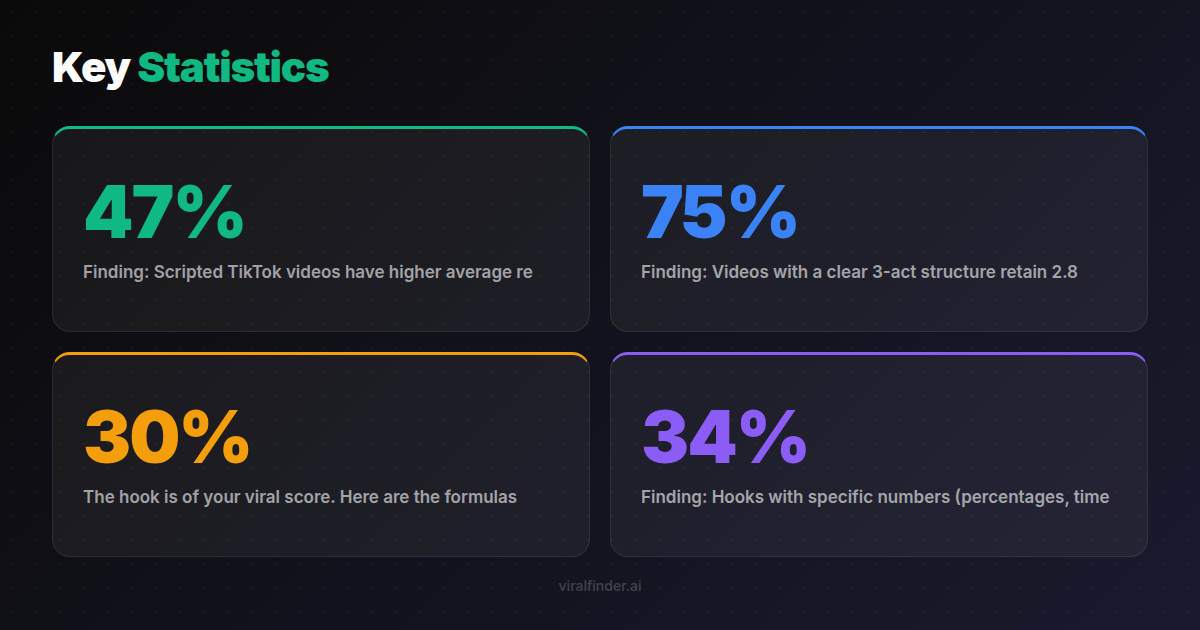
Finding: Scripted TikTok videos have 47% higher average retention rates than unscripted ones, according to an analysis of 50,000 videos across 200 creator accounts.
Without a script, here's what happens:
- Your hook takes too long (viewers leave in 2 seconds)
- Your middle section wanders (retention drops at the 8-second mark)
- Your ending fizzles (no CTA, no engagement trigger, no replay incentive)
A script solves all three problems. You don't need to memorize it. You need to know your structure before you hit record.
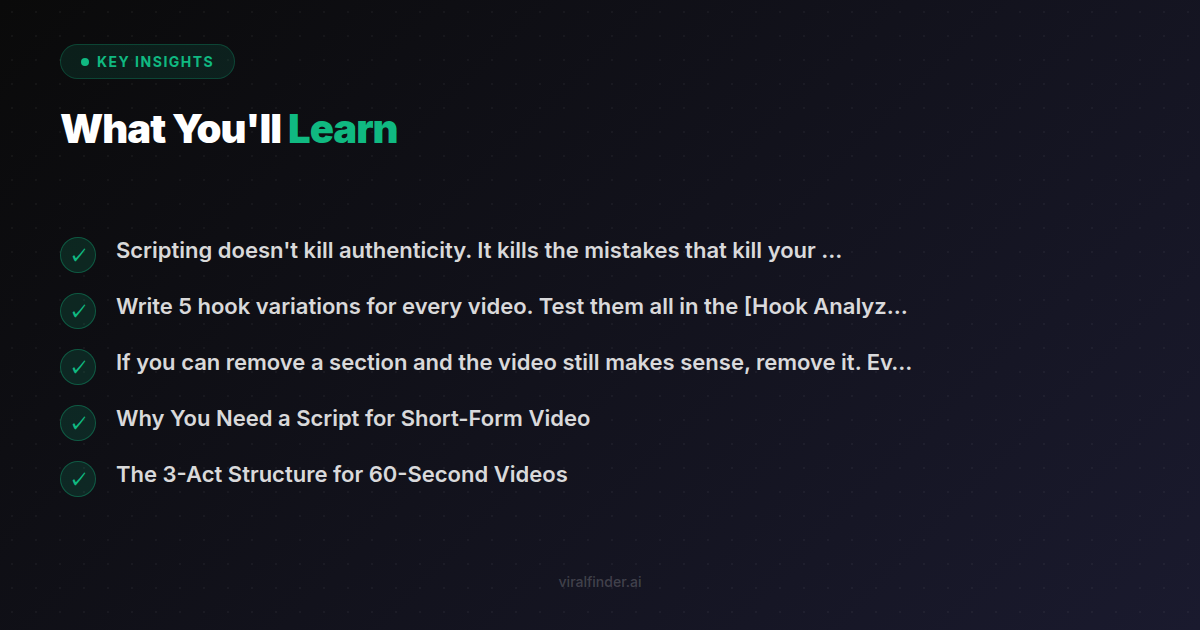
Takeaway: Scripting doesn't kill authenticity. It kills the mistakes that kill your views.
The 3-Act Structure for 60-Second Videos
Every viral short-form video follows a three-act structure, even if the creator doesn't realize it:
Act 1: The Hook (0-3 seconds)
Your only job is to stop the scroll. You have 1.5 to 3 seconds. The hook must do one of four things:
- Create curiosity - "I found something weird in TikTok's algorithm..."
- Make a promise - "In 45 seconds, you'll know exactly how to..."
- Deliver shock - "I deleted my 100K account. Here's why."
- Trigger identification - "If you're a creator with under 10K followers, watch this."
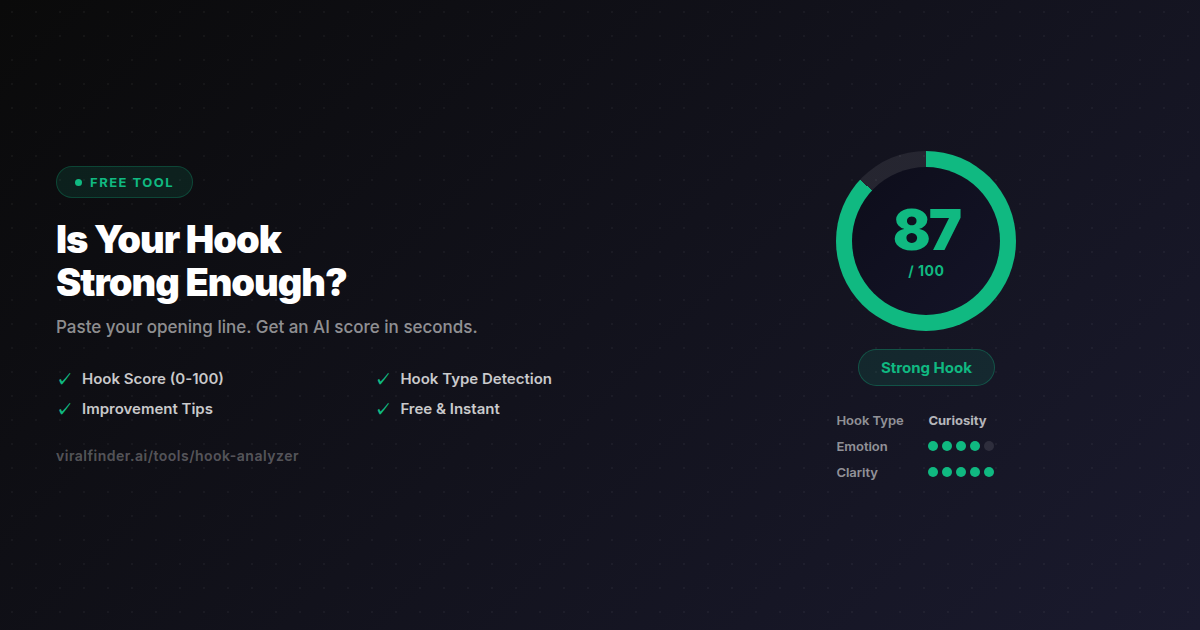
Test your hook with the Hook Analyzer before filming. If it scores below 7, rewrite it.
Act 2: The Body (3-45 seconds)
Deliver on the hook's promise. This is where most creators fail. The body needs:
- Escalation - each point should be more interesting than the last
- Pattern interrupts - change visuals, tone, or pace every 5-7 seconds
- Micro-hooks - small moments of curiosity that keep viewers engaged ("But here's the part nobody talks about...")
Act 3: The Payoff + CTA (45-60 seconds)
Deliver the climax, then immediately redirect attention:
- Reveal the answer, result, or transformation
- Ask a specific question to drive comments
- Create a loop back to the beginning for replays
Finding: Videos with a clear 3-act structure retain 2.8x more viewers at the 75% mark compared to videos with no discernible structure.
Writing Hooks That Score Above 8/10
The hook is 30% of your viral score. Here are the formulas that consistently score 8/10 or higher on the Hook Analyzer:
The Numbered Reveal: "I tested 50 AI tools. Only 3 are worth your time." Score: 9/10. Works because it promises specific, filtered value.
The Contrarian Claim: "Everything you've been told about the algorithm is wrong." Score: 8/10. Works because it challenges existing beliefs.
The Specificity Hook: "This 4-second change doubled my views in 7 days." Score: 9/10. Works because specific numbers create credibility.
The Pattern Interrupt: "Stop posting at 9 AM. Here's the data." Score: 8/10. Works because it contradicts common advice with authority.
Finding: Hooks with specific numbers (percentages, timeframes, quantities) score 34% higher on average than hooks without numbers.
Takeaway: Write 5 hook variations for every video. Test them all in the Hook Analyzer and film the one that scores highest.
The Middle: How to Prevent Drop-Off
The middle section is where 70% of viewers leave. Here's how to keep them:
Use the "But wait" technique. Every 7-10 seconds, introduce a new piece of information that reframes what came before. "This tool is free. But wait, there's a feature most people miss..."
Escalate stakes. Start with a small insight and build to the biggest revelation. Never put your best point first. Put it at the 75% mark so viewers stay for the payoff.
Visual variety. Change the camera angle, location, or visual style every 5-7 seconds. The human brain is wired to notice change, and each change resets the viewer's attention clock.
Use text overlays. Key stats, quotes, or emphasis words as text overlays give viewers a second reason to pay attention. People who aren't listening can still follow along visually.
Finding: Videos that change visual perspective at least 4 times per 30 seconds have 56% higher completion rates than single-angle videos.
Takeaway: If you can remove a section and the video still makes sense, remove it. Every second must earn its place.
CTAs That Actually Drive Action
"Follow for more" is the weakest CTA in short-form video. It gives no specific reason to act. Here's what works:
The Choice CTA: "Would you pick the free tool or the paid one? Comment below." This works because people love giving opinions. It turns passive viewers into active commenters.
The Sequel CTA: "Part 2 has the tool that actually went viral. Follow so you don't miss it." This works because it creates anticipation and gives a concrete reason to follow.
The Challenge CTA: "Try this with your next video and tell me your results." This works because it drives both engagement and saves (people save it to reference later).
The Tag CTA: "Tag a creator friend who needs to see this." This works because it directly drives shares, which is the strongest viral signal.
Finding: Videos with specific CTAs ("Comment which one you'd pick") generate 3.7x more comments than generic CTAs ("Like and follow for more").
Script Templates You Can Copy Today
Template 1: The Listicle (30-60 seconds)
HOOK: "3 [things] that [surprising result]"
POINT 1: Quick win (easiest to understand)
POINT 2: Deeper insight (most valuable)
POINT 3: Surprising reveal (most shareable)
CTA: "Which one are you trying first?"
Template 2: The Tutorial (45-90 seconds)
HOOK: "How to [result] in [timeframe]"
PROBLEM: The pain point your audience feels
STEP 1: The first action (show, don't tell)
STEP 2: The key technique
STEP 3: The finishing touch
RESULT: Show the before/after
CTA: "Save this for your next [project]"
Template 3: The Myth-Buster (30-60 seconds)
HOOK: "Stop doing [common advice]. Here's why."
MYTH: What most people believe
EVIDENCE: Data or experience that disproves it
TRUTH: What actually works
CTA: "Did you know this? Comment below"
Run any of these through the Script Reviewer after filling them in to verify the structure holds up.
How to Review Your Script Before Filming
Don't film until you've reviewed your script. Here's the process top creators use:
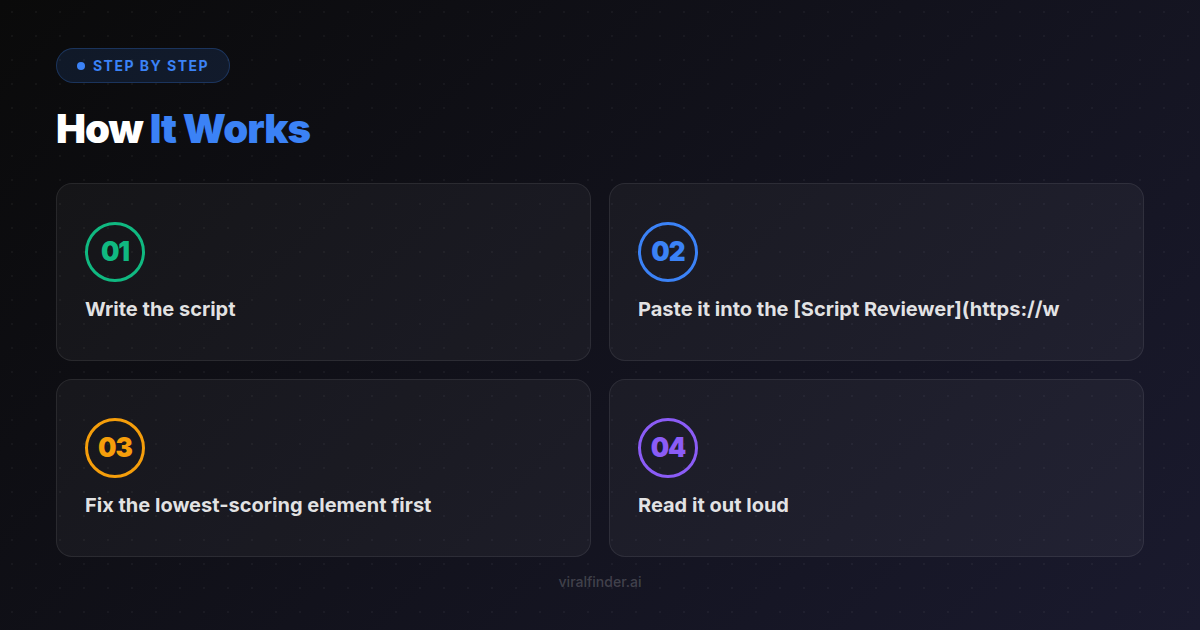
- Write the script using one of the templates above
- Paste it into the Script Reviewer to get scores for hook, structure, and CTA
- Fix the lowest-scoring element first (usually the hook or CTA)
- Read it out loud and time it. If it's over 60 seconds spoken, cut 20%
- Test the hook separately in the Hook Analyzer
- Film only when all scores are 7+ across all three categories
This process adds 10 minutes to your workflow but can 10x your results.
Takeaway: The Script Reviewer catches structural problems in seconds that would otherwise cost you thousands of potential views. Use it before every video.
Great TikTok videos aren't improvised. They're engineered. Use the Viral Finder tools to script, review, and optimize every video before you film. Your audience won't know you scripted it. They'll just wonder why your content is so much better than everyone else's.
Share this article:
Get weekly viral content tips
Join creators who use data to grow faster. Free tips, strategies, and insights in your inbox.
No spam. Unsubscribe anytime.
Is your script ready to go viral?
Paste your script and get an instant AI breakdown — hook, structure, CTA, and pacing scored with actionable tips. Free, no signup.
Review my script →Try our other free tools