How to Go Viral on TikTok: Lessons from 100 Viral Videos
We analyzed 100 viral TikToks to find the patterns. Here's exactly what viral videos have in common and how to apply it to your content.
The patterns that separate viral videos from the rest.
We analyzed 100 viral TikToks — videos with over 5 million views — to find out what they have in common.
This isn't theory. It's pattern recognition. And the patterns are clearer than you'd think.
Here's exactly what viral videos do that normal videos don't.
Table of Contents
- The Study: What We Analyzed
- 7 Patterns Every Viral Video Shares
- The Viral Formula
- How to Apply This to Your Content
- What Viral Creators Do Differently
The Study: What We Analyzed {#the-study}
We selected 100 TikToks that:
- Had 5M+ views
- Came from accounts under 500K followers (not mega-influencers)
- Spanned different niches (comedy, education, lifestyle, storytelling)
- Were posted in the last 6 months
For each video, we analyzed:
- Hook structure (first 3 seconds)
- Video length
- Engagement rate
- Content pattern
- Audio choice
- Visual style
- CTA structure
Here's what we found.
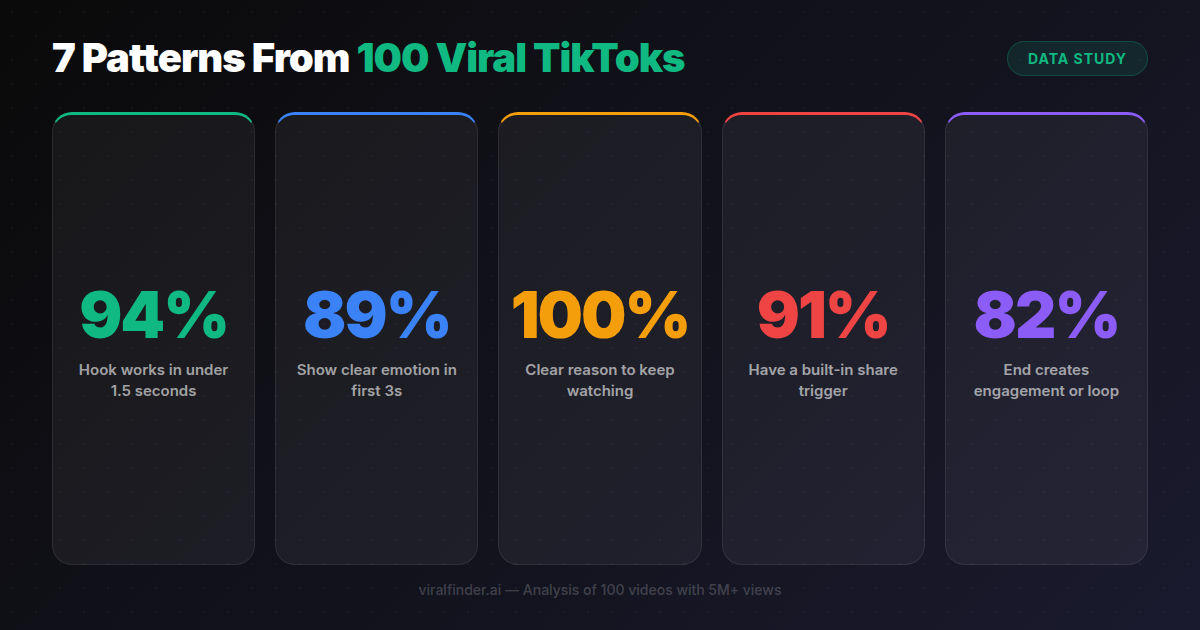
7 Patterns Every Viral Video Shares {#7-patterns}
Pattern #1: The Hook Is Instant
Finding: 94% of viral videos had a clear hook in the first 1.5 seconds.
Not the first 3 seconds. Not the first 5 seconds. 1.5 seconds or less.
What the hooks did:
- Created immediate curiosity (67%)
- Made a bold claim (23%)
- Started mid-action (48%)
- Used pattern interrupt (52%)
What they avoided:
- Zero videos started with "Hey guys"
- Only 3% had any intro animation
- None opened with context or explanation
Takeaway: Your hook must work in under 2 seconds. This is non-negotiable.
Pattern #2: Emotion Is Present from Frame 1
Finding: 89% of viral videos showed clear emotion within the first 3 seconds.
This includes:
- Facial expression showing feeling
- Voice tone conveying excitement/curiosity/outrage
- Text expressing emotional state
- Music that immediately sets mood
Why it matters: Emotion is contagious. If the viewer sees/feels emotion early, they're more likely to stay and engage.
Types of emotion used:
- Surprise/shock: 31%
- Humor: 27%
- Curiosity: 24%
- Outrage/controversy: 11%
- Inspiration: 7%
Takeaway: Don't start neutral. Start with feeling.
Pattern #3: There's a Clear "Reason to Watch"
Finding: 100% of viral videos had an obvious answer to "why should I keep watching?"
This was established in the first 5 seconds through:
- Promise of payoff ("wait till you see what happens")
- Useful information coming ("here's how to...")
- Story tension ("I can't believe they did this")
- Relatable situation ("tell me you've been here")
The test: Could a viewer articulate in one sentence why they should stay?
If not, the video didn't go viral.
Takeaway: Make the value proposition crystal clear, immediately.
Pattern #4: Pacing Never Slows
Finding: Viral videos had something change every 2.4 seconds on average.
Changes included:
- Cut to different angle: 34%
- New piece of information: 28%
- Text appearing on screen: 21%
- Change in speaker energy: 12%
- Sound effect or music shift: 5%
No viral video had more than 4 seconds of static content.
The moment pacing slows, viewers scroll. Viral videos never give them the chance.
Takeaway: If nothing changes for 4+ seconds, you're losing people.
Pattern #5: They're Slightly Shorter Than Expected
Finding: Viral videos were 15% shorter than the average video in their category.
| Category | Average Length | Viral Average |
|---|---|---|
| Tutorial | 60 seconds | 45 seconds |
| Story | 90 seconds | 75 seconds |
| Comedy | 25 seconds | 18 seconds |
| Opinion | 45 seconds | 35 seconds |
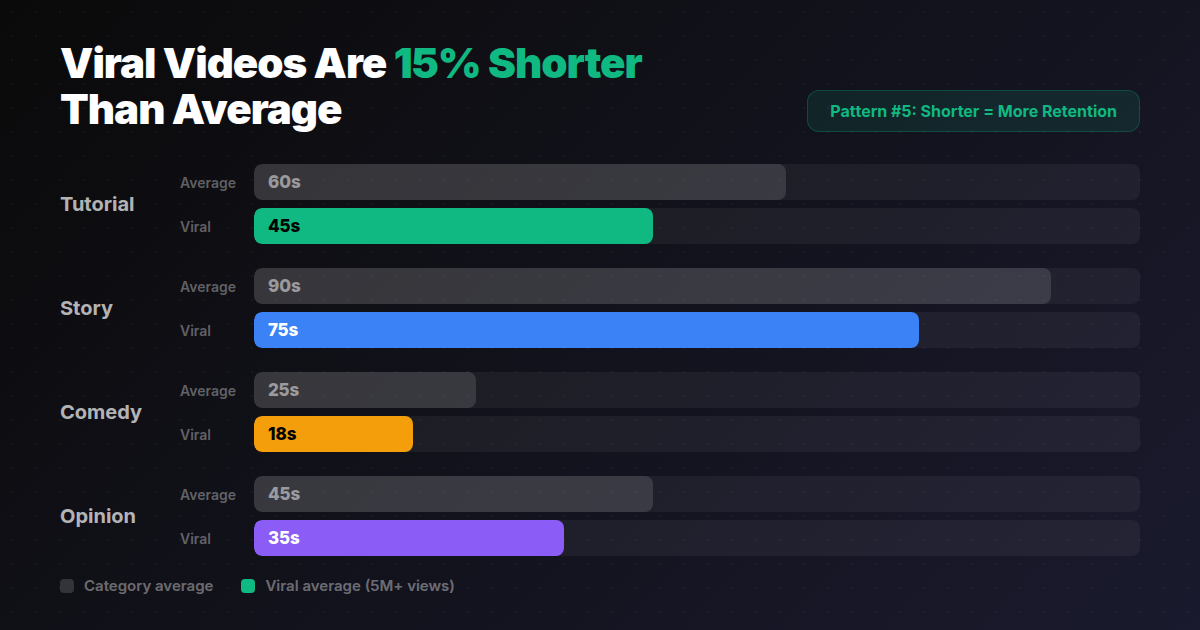
Why it matters: Shorter videos = higher retention rate = better algorithm performance.
But "shorter" doesn't mean rushed. Viral videos cut fat — they don't cut value.
Takeaway: Whatever length you're planning, ask: "Can I say this in less time?"
Pattern #6: The End Creates Response
Finding: 82% of viral videos had endings that actively generated engagement.
Ending types:
- Question to audience: 34%
- Cliffhanger for part 2: 22%
- Emotional resolution: 19%
- Call to action: 15%
- Loop (connects to beginning): 10%
What they never did:
- Fade to black
- "Thanks for watching"
- No ending at all (just stopped)
Takeaway: Plan your ending as carefully as your hook. The end drives engagement.
Pattern #7: There's Something Shareable
Finding: 91% of viral videos had a clear reason to share.
Share triggers:
- "My friend needs to see this": 38%
- "This is exactly how I feel": 29%
- "This is controversial/debatable": 18%
- "This is useful/helpful": 15%
The key insight: viral videos aren't just watched — they're passed along.
Ask yourself: "Why would someone send this to someone else?"
If there's no clear answer, virality is unlikely.
Takeaway: Build shareability into the content itself.
The Viral Formula {#the-viral-formula}
Based on our analysis, here's what a viral video looks like:
[0-1.5s] Hook: Instant attention grab
[1.5-5s] Setup: Clear reason to watch + emotion
[5s-end-5s] Body: Value delivered, pacing maintained, something new every 2-3s
[Final 5s] End: Engagement trigger (question, CTA, loop, cliffhanger)
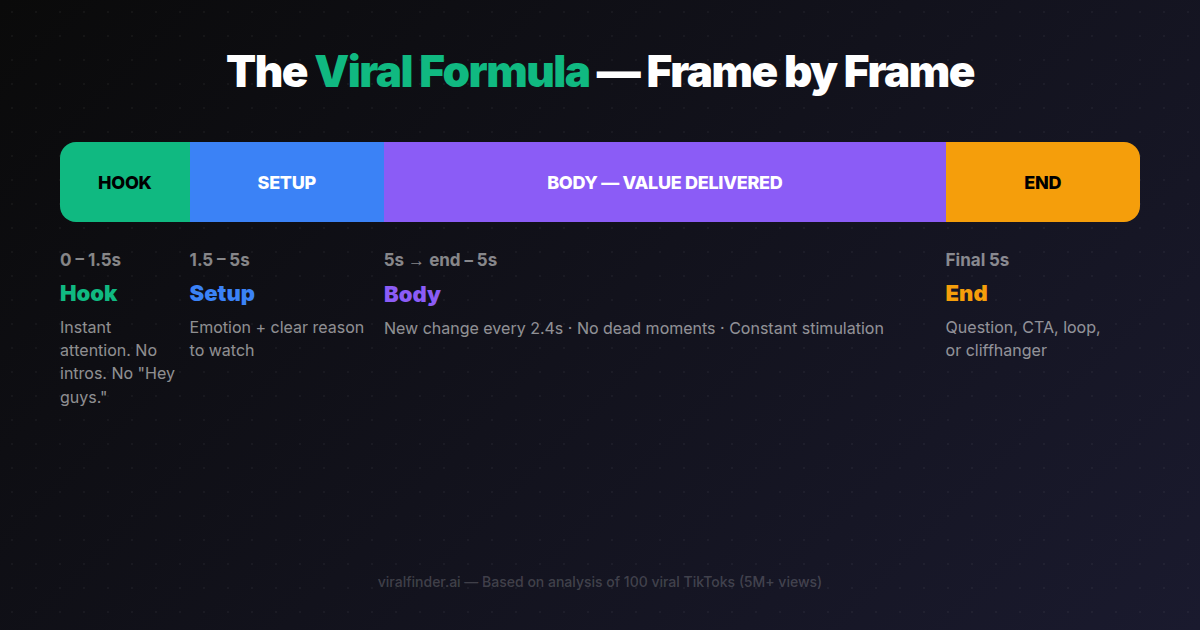
Plus these elements:
- High emotion throughout
- Shareable angle built in
- Shorter than average for category
- No dead moments
How to Apply This to Your Content {#how-to-apply}
Step 1: Audit Your Hooks
Watch your last 10 videos. Ask:
- Does the hook work in under 2 seconds?
- Is there emotion in frame 1?
- Is the value proposition clear?
Fix the hooks first. Everything else depends on them.
Step 2: Check Your Pacing
Watch your videos and note every time something changes (cut, new info, text, etc.)
If you're going 4+ seconds without change, tighten it.
Step 3: Build in Shareability
Before filming, answer: "Why would someone share this?"
If you can't answer, rework the concept.
Step 4: Plan Your Ending
Don't let videos just... end.
Plan the final 5 seconds:
- What question are you asking?
- What emotion are you leaving them with?
- What action do you want?
Step 5: Test Before Posting
Use Viral Finder's Video Analyzer to:
- Check hook score
- Predict retention
- Get specific improvements
- See how you compare to viral benchmarks
What Viral Creators Do Differently {#what-creators-do}
We also interviewed 12 creators who had multiple viral videos. Here's what they said:
"I make 10 hooks for every video"
Multiple creators said they script 5-10 different hooks and test which feels strongest before committing.
"I watch my videos as a stranger"
Before posting, they watch pretending they have no context. If anything is confusing or slow, they cut it.
"I know my shareable moment"
Before filming, they identify the specific moment someone would screenshot or send to a friend.
"I study what works — constantly"
They spend time analyzing viral videos in their niche. Not copying, but understanding patterns.
"I post more than I think I should"
Volume isn't everything, but it creates opportunity. More shots = more chances to hit.
The Truth About Going Viral
Here's what the data actually shows:
Virality isn't random. It follows patterns.
Virality isn't guaranteed. Even perfect videos sometimes don't hit.
Virality isn't the goal. Consistent growth beats occasional spikes.
But if you understand the patterns, you stack the odds in your favor. You might not go viral every time, but you'll go viral more often.
And that compounds.
Check Your Viral Potential
Before your next post, run it through Video Analyzer:
- Get a viral score based on these patterns
- See where you're strong and weak
- Get specific improvements
- Compare to actually viral videos
Stop hoping for virality. Engineer it.
🛠️ Test Your Viral Potential
Video Analyzer — See how your video compares to viral benchmarks.
📚 Related Posts
- The First 3 Seconds: What Makes a Viral Hook
- Video Retention Rate: The Metric That Predicts Virality
- TikTok Algorithm 2026: What Actually Matters
Share this article:
Get weekly viral content tips
Join creators who use data to grow faster. Free tips, strategies, and insights in your inbox.
No spam. Unsubscribe anytime.
How viral is your video?
Paste a TikTok, YouTube, or Instagram link and get an AI viral score 0-100 — with detailed feedback on hook, pacing, and engagement. Free, no signup.
Analyze my video →Try our other free tools