How to Write a TikTok Script That Keeps Viewers (2026)
Learn the exact script structure that holds viewer attention. Templates for 15s, 30s, and 60s videos plus common mistakes to avoid.
The exact structure that keeps people watching until the end.
Most TikTok scripts fail because they're written like essays — introduction, body, conclusion.
But TikTok isn't an essay. It's a performance. And the audience has their finger on the skip button the entire time.
This guide shows you how to write scripts that hold attention from the first word to the last.
<video src="https://s3.us-east-1.amazonaws.com/remotionlambda-useast1-k5qomcb1pb/renders/x83p8ewwwd/out.mp4" controls playsinline style="width:100%;border-radius:12px;margin:24px 0;"></video>
Table of Contents
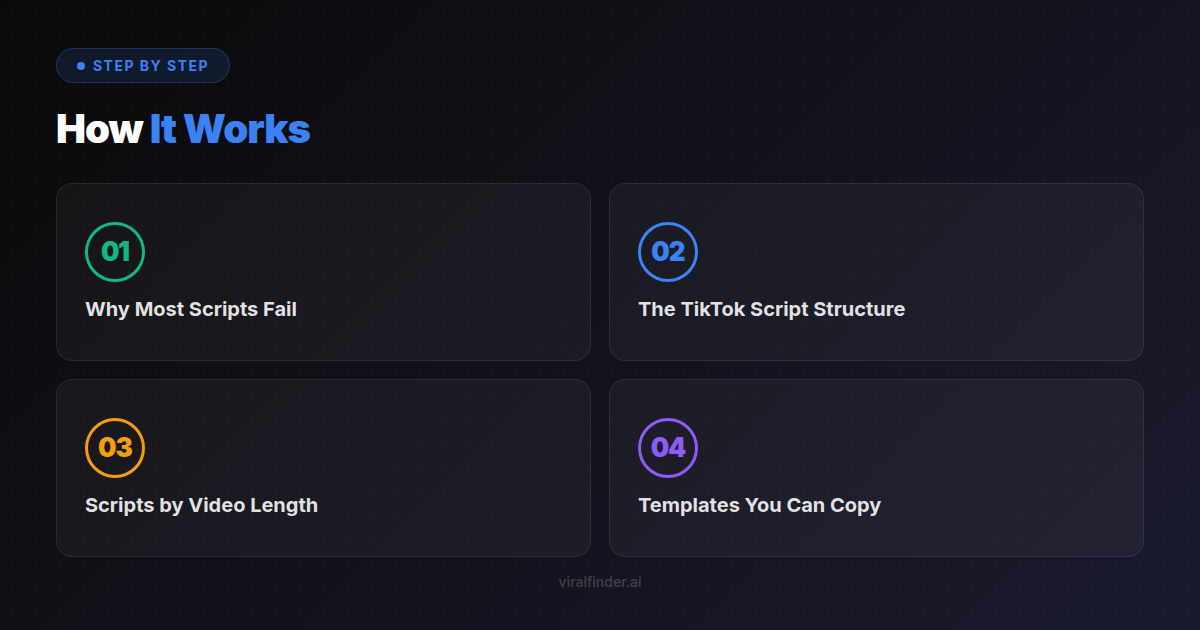
- Why Most Scripts Fail
- The TikTok Script Structure
- Scripts by Video Length
- Templates You Can Copy
- Common Script Mistakes
Why Most Scripts Fail {#why-most-scripts-fail}
Traditional content structure:
- Introduction
- Context
- Main content
- Conclusion
TikTok structure:
- Hook (or you're dead)
- Value/Entertainment
- Payoff
- Call to action
See the difference?
In traditional content, you earn attention gradually. On TikTok, you start with maximum attention and fight to keep it.
The Retention Death Valley
Every video has a "death valley" — the point where most viewers drop off.
For most TikToks, that's around the 5-7 second mark. Right after the hook, right before the value kicks in.
Your script needs to bridge that gap. There can be no dead moments.
The TikTok Script Structure {#the-tiktok-script-structure}
The 4-Part Framework
Part 1: The Hook (0-3 seconds)
- One sentence maximum
- Creates curiosity or tension
- Visual and verbal must align
Part 2: The Setup (3-7 seconds)
- Establishes context quickly
- Raises stakes
- Promises payoff
Part 3: The Body (7 seconds to near-end)
- Delivers the value
- Maintains pace
- No filler
Part 4: The Payoff + CTA (final 3-5 seconds)
- Delivers on the promise
- Adds unexpected element if possible
- Clear next step
The Pacing Rule
Something must change every 2-3 seconds:
- New visual
- New piece of information
- New speaker/voice
- Change in energy
- Text on screen
If nothing changes for 5 seconds, you've lost people.
Scripts by Video Length {#scripts-by-video-length}
15-Second Script Template
[0-2s] Hook: "Here's the one thing that changed my [area]"
[2-6s] Setup: "I tried everything. Nothing worked until I discovered this."
[6-12s] Body: "[The main point/reveal/tip — keep it simple and specific]"
[12-15s] Payoff + CTA: "Try it and tell me if it works. Follow for more."
30-Second Script Template
[0-3s] Hook: "Stop doing [common thing]. Here's why."
[3-8s] Setup: "Everyone thinks [common belief], but that's actually making [problem] worse."
[8-20s] Body: "What you should do instead is [solution]. Here's how:
- Point 1
- Point 2
- Point 3"
[20-27s] Evidence: "When I switched to this, [result]."
[27-30s] CTA: "Save this for later. Drop a comment if you have questions."
60-Second Script Template
[0-3s] Hook: "The reason your [thing] isn't working has nothing to do with [obvious factor]"
[3-10s] Setup/Problem: "You've probably tried [common solutions]. I did too. None of it worked because we were solving the wrong problem."
[10-15s] Bridge: "The real issue is [actual problem]. And once you understand that, everything changes."
[15-40s] Body/Solution: "Here's what actually works: Step 1: [Specific action] — This matters because [reason] Step 2: [Specific action] — This is where most people mess up Step 3: [Specific action] — This is the game changer"
[40-50s] Evidence: "I used this exact method to [personal result]. And I've seen it work for [others]."
[50-57s] Summary: "So remember: [1-sentence summary of main point]"
[57-60s] CTA: "Follow for more [topic] tips. Link in bio if you want [resource]."
3-Minute Script Template
For longer content, think in acts:
Act 1: The Hook & Promise (0-15s)
- Hook: 0-5s
- Stakes: 5-10s
- Promise: 10-15s
Act 2: The Setup (15-45s)
- The problem explained
- Why it matters
- What doesn't work
Act 3: The Solution (45s-2m)
- Your main content
- Broken into clear sections
- Pattern interrupts every 15-20s
Act 4: The Payoff (2m-2:45m)
- Results/evidence
- Emotional resolution
- Summary
Act 5: The Close (2:45m-3m)
- CTA
- Tease next content
- Sign-off
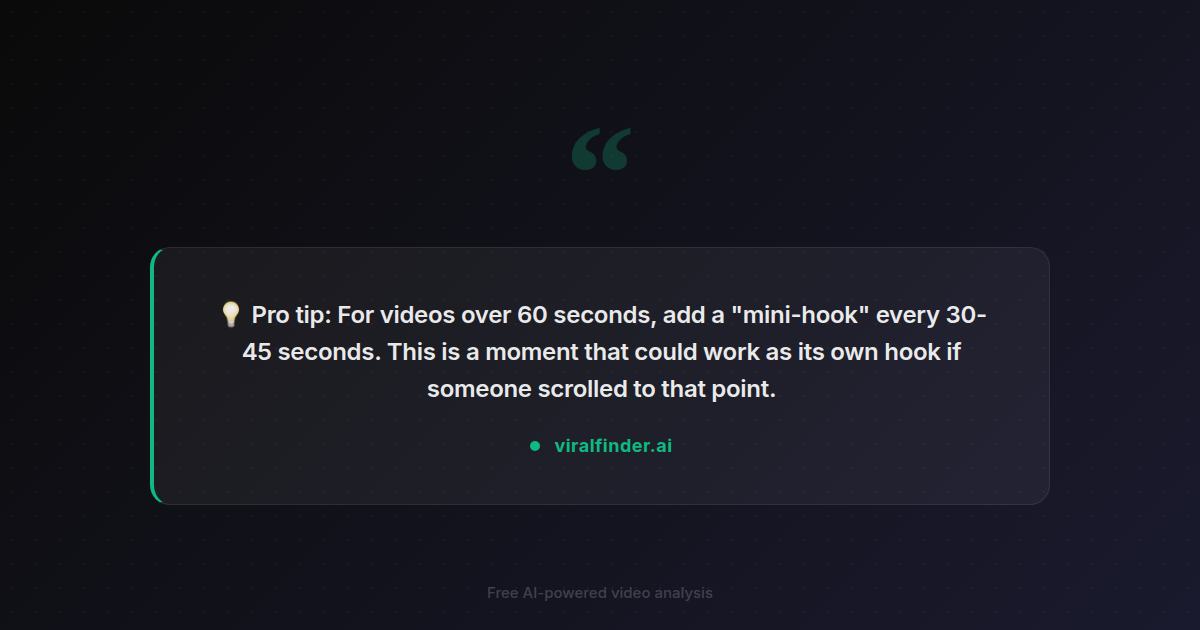
💡 Pro tip: For videos over 60 seconds, add a "mini-hook" every 30-45 seconds. This is a moment that could work as its own hook if someone scrolled to that point.
Templates You Can Copy {#templates-you-can-copy}
Template 1: The Tutorial
[Hook] Stop doing [thing] wrong — let me show you the right way.

[Setup] Most people think [common approach]. That's why their [thing] looks like [bad result].

[Body] Here's what you actually do:
First, [step 1]. See how [observation]?
Next, [step 2]. This is the part everyone skips.
Finally, [step 3]. And that's what makes the difference.

[Payoff] Now it looks like [good result].

[CTA] Save this for when you need it.
Template 2: The Story
[Hook] This is the [superlative] thing that ever happened to me.

[Setup] So I was [situation], minding my own business, when [inciting incident].

[Rising Action] At first I thought [initial reaction]. But then [complication].

[Climax] And that's when [the big moment].

[Resolution] In the end, [outcome and lesson].

[CTA] Has anything like this ever happened to you? Comment below.
Template 3: The Hot Take
[Hook] [Controversial opinion about common topic]

[Acknowledge] I know everyone loves [popular thing], but hear me out.

[Argument] The truth is [your reasoning]. And here's why:
Point 1
Point 2
Point 3

[Evidence] I used to think differently until [personal experience].

[Softener] I'm not saying [extreme version]. I'm saying [nuanced version].

[CTA] What do you think? Am I crazy? Tell me in the comments.
Template 4: The Listicle
[Hook] X [things/ways/tips] that will [desirable outcome]

[Setup] If you're struggling with [problem], you need these.

[Item 1] Number one: [tip]. This works because [reason].

[Item 2] Number two: [tip]. I use this every day.

[Item 3] Number three: [tip]. Most people don't know this one.

[Bonus] And a bonus: [extra tip].

[CTA] Which one are you trying first? Follow for more.
Template 5: The Before/After
[Hook] This is what I looked like before [thing]. Here's after.

[Before] I used to [problem/struggle]. It was [negative emotion].

[Turning Point] Then I discovered [solution/method].

[Process] Here's what I did:
- [Action 1]
- [Action 2]
- [Action 3]

[After] Now [positive result].

[CTA] If I can do it, you can too. Link in bio.
Common Script Mistakes {#common-script-mistakes}
Mistake #1: Too Much Setup
Your audience doesn't need context. They need value.
❌ "So I've been wanting to make this video for a while because a lot of people have been asking me about this topic and I think it's really important..."
✅ "Here's the answer to your most asked question."
Mistake #2: Filler Words
Every "um," "like," "you know," and "basically" is a chance for someone to scroll.
Script them out. Read your script aloud and cut anything unnecessary.
Mistake #3: Burying the Value
Don't save the best for last. Give value early, give more value in the middle, end with value.
If your best point is at the end, 70% of viewers will never hear it.
Mistake #4: No Payoff
If you promise something in the hook, deliver it. Bait-and-switch destroys trust.
Mistake #5: Weak CTA
"Follow me" is generic. Be specific about what they get.
❌ "Follow for more content" ✅ "Follow if you want one tip like this every day"
Before You Post
Test your script with Viral Finder's Video Analyzer:
- Check if your hook is strong enough
- See predicted retention points
- Get specific feedback on pacing
Upload your video and know if the script works before you commit to posting.
🛠️ Test Your Script
Video Analyzer — See if your script keeps viewers watching with AI-powered analysis.
📚 Related Posts
- The First 3 Seconds: What Makes a Viral Hook
- TikTok Hook Examples: 50 Viral Openers
- Video Retention Rate: The Metric That Predicts Virality
Share this article:
Get weekly viral content tips
Join creators who use data to grow faster. Free tips, strategies, and insights in your inbox.
No spam. Unsubscribe anytime.
Is your script ready to go viral?
Paste your script and get an instant AI breakdown — hook, structure, CTA, and pacing scored with actionable tips. Free, no signup.
Review my script →Try our other free tools